
 Image 1 of 5
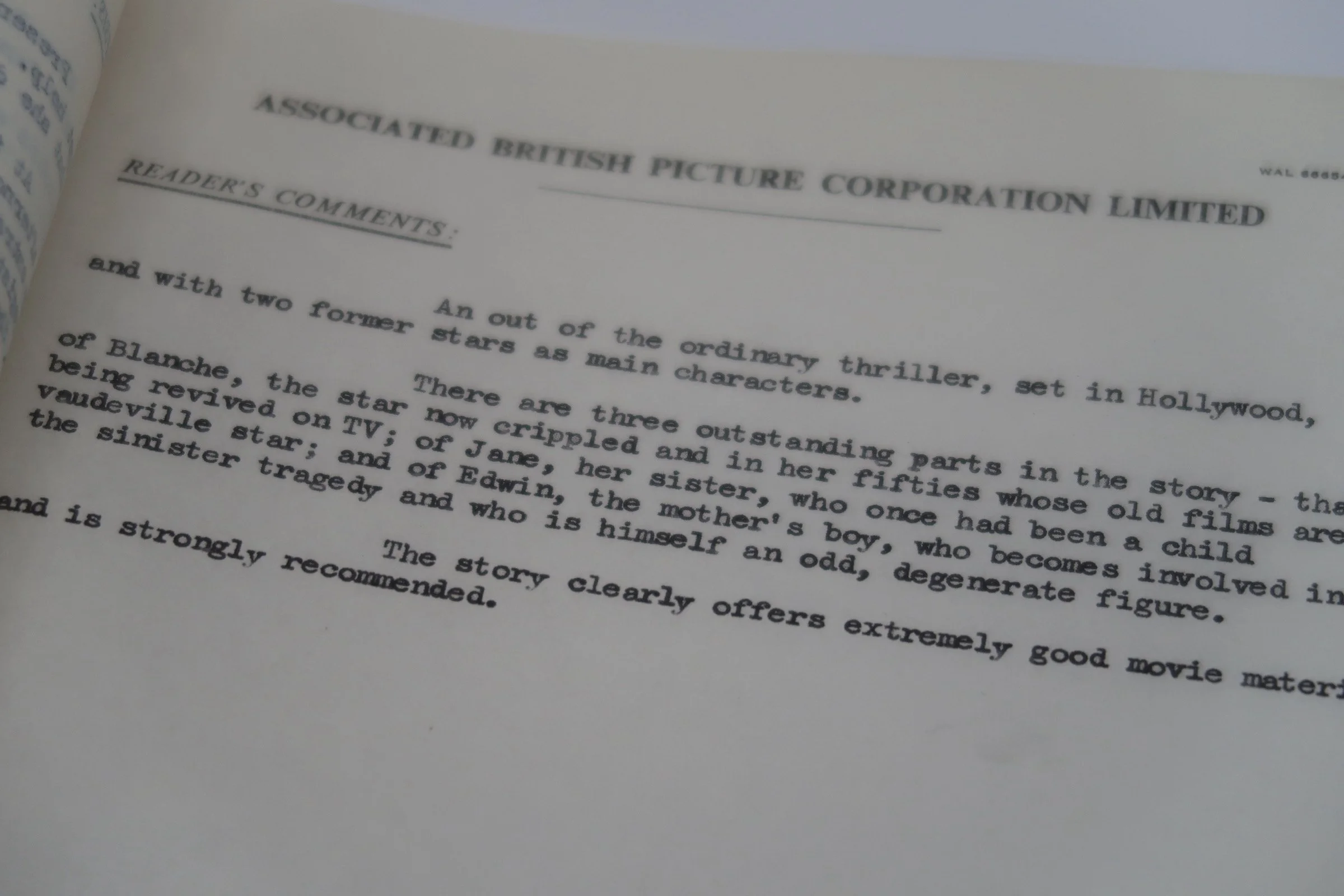 Image 2 of 5
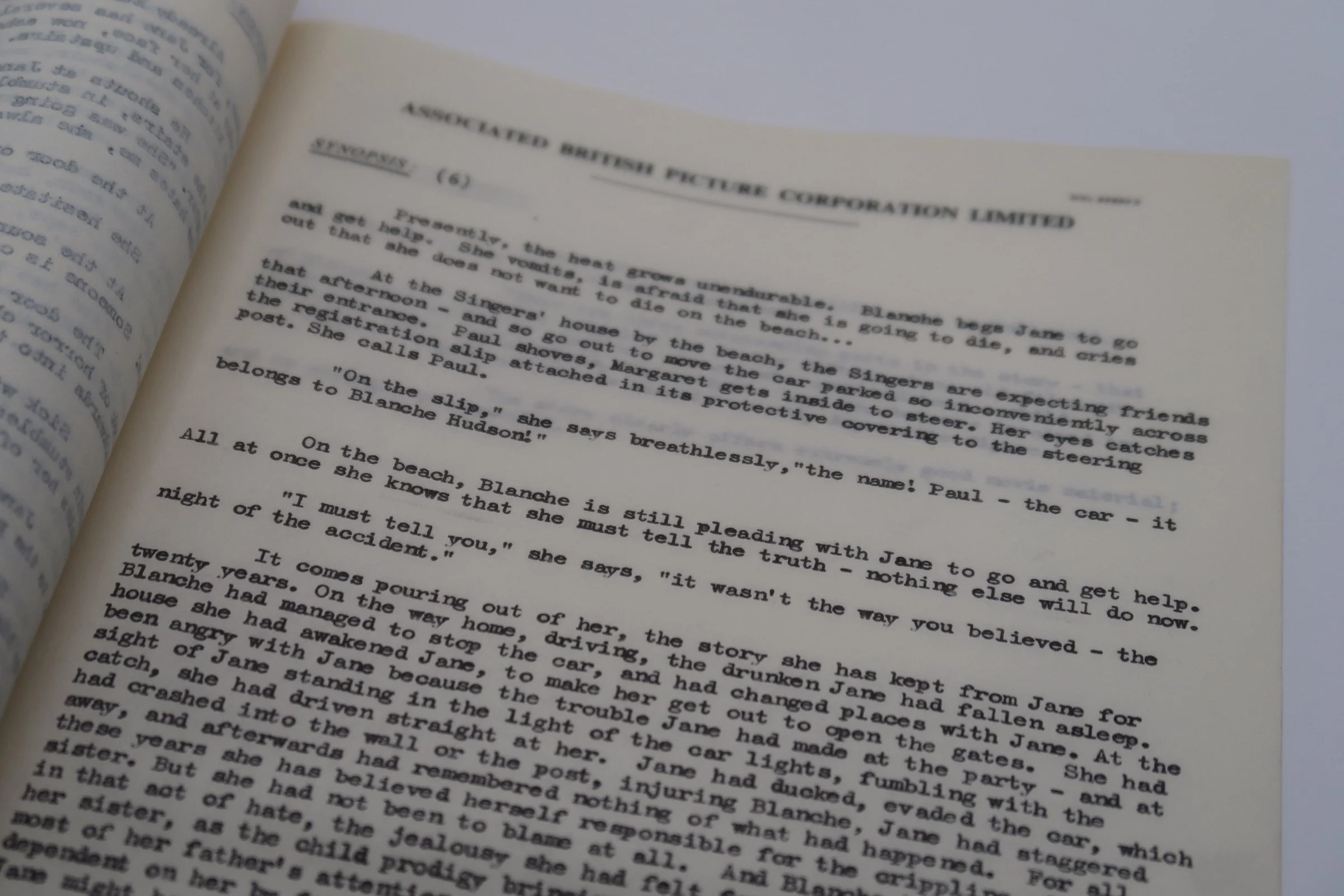 Image 3 of 5
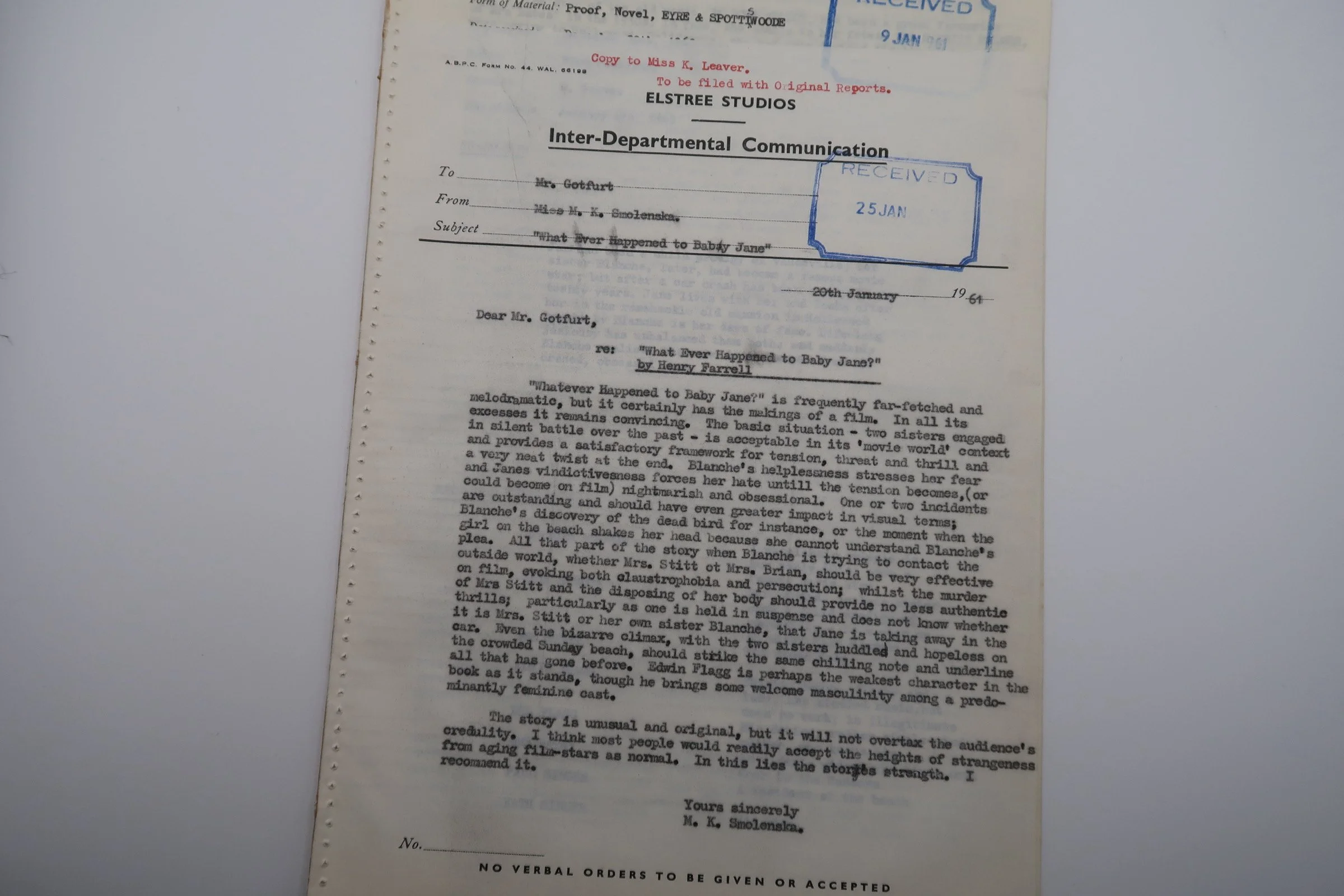 Image 4 of 5
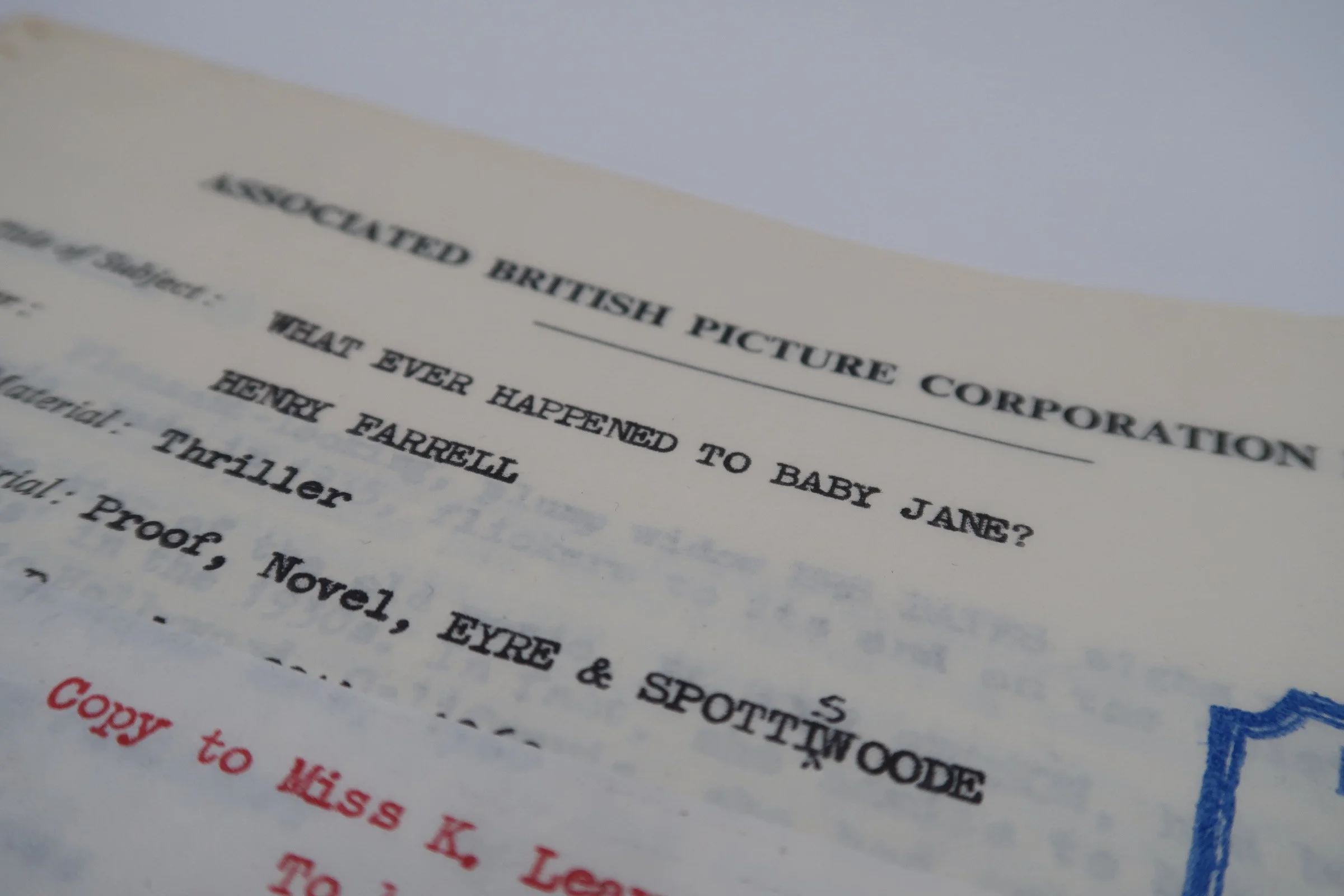 Image 5 of 5
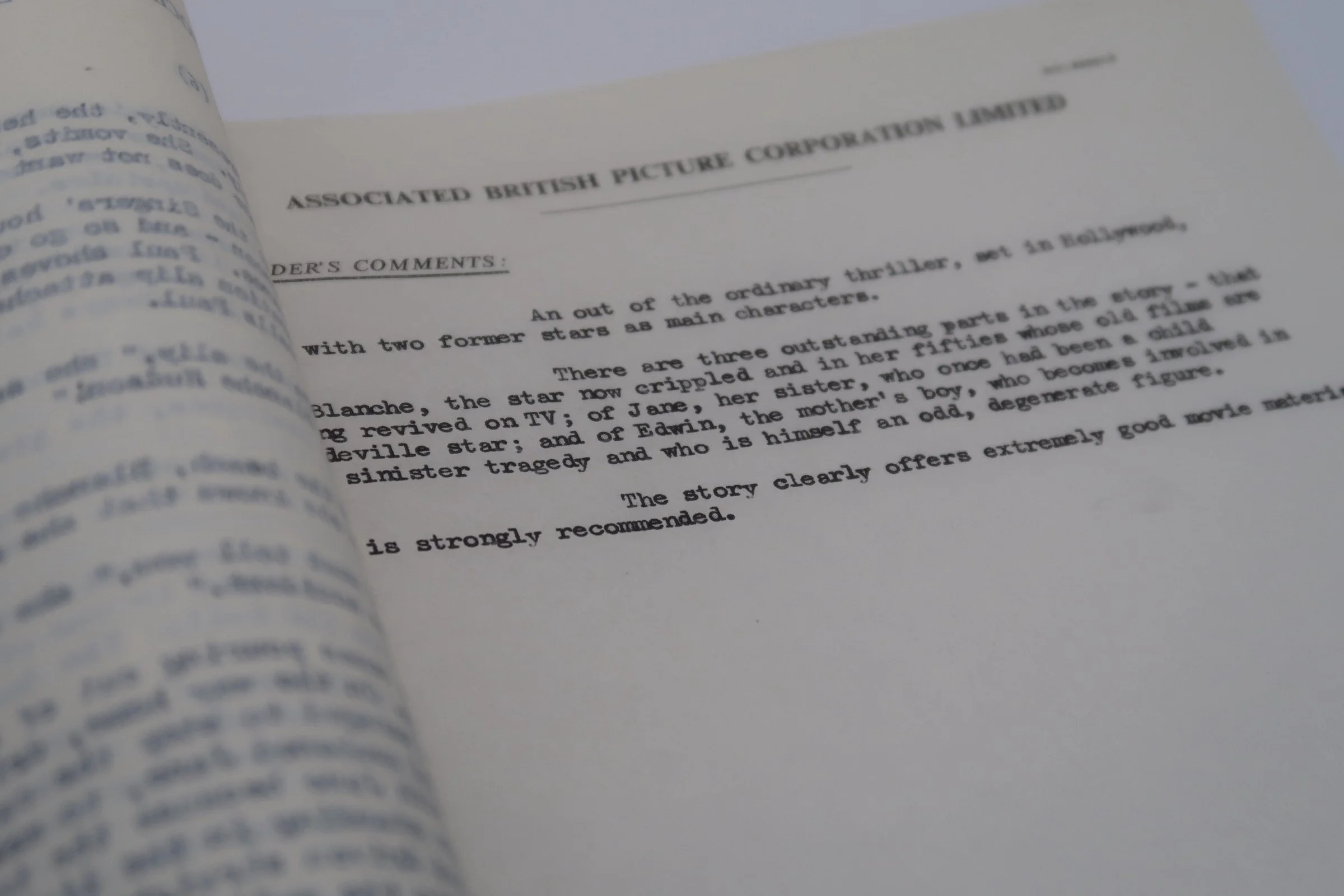
‘...With two former stars as main characters.’
[FARRELL, Henry] [Elstree Studios] GROVES, R, SMOLENSKA, M.K. What Ever Happened To Baby Jane? : Two ABPC readers’ report, assessing the novel’s potential for screen adaptation
N.p. [Elstree]: N.p. [ABPC], 1961.
9pp. typed report on rectos only, receipt stamps to first page of each dated 9th and 25th January 1961. Perforations down left edge from office binding. Very well preserved.
Located in a corner block on the Elstree lot opposite the main administration building, the job of Associated British Picture Corporation’s Reading Department was to identify potential film projects for the studio. Most of the material considered by the studio came in the form of new novels, either selected by the readers themselves or submitted to ABPC by their authors’ literary agents. Unsolicited screenplays were also read, as were older titles by authors whose work had enjoyed recent screen success and whose back catalogues might contain other ideas for films. Readers also attended new plays to assess their filmic possibilities.
All reports were written and presented in strict accordance with ABPC’s house style. The first page would carry author, title and genre, how and by whom the work had been submitted, and a date stamp indicating when it had been received. The writer of the report would also usually be identified, either by name or initials (the readerS in this case were R Groves and M.K. Smolenska). A brief outline would be given (’SUMMARY’), and there would then follow a long and detailed synopsis (’STORY’). More a potted version of the work under consideration rather than a mere outline of the story, the Story would be sufficiently thorough to provide those reading it with a full working knowledge of the material, removing the need for them to read the full book themselves. Finally, the reader would give their verdict on the work, and detailed reasons for their decision (’COMMENT’). In almost all cases, the verdict would be ‘Not Recommended’; occasionally, the reader would call for a second opinion; and very occasionally, the reader would recommend fast-tracking material to studio heads for their immediate consideration. The system was far-reaching, diligent and rigorous.
Based on the novel of the same name, written by Henry Farrell and published in 1960. The reader’s report for Elstree notes that the script was submitted as a “proof of a novel” sent directly by the publisher (Eyre and Spottiswoode) on December 20th, 1960, and the two reports were generated on January 4th & 20th of 1961.
The Readers’ Comments are both rare wholehearted recommendations for the potential for adaptation for the book: “An out of the ordinary thriller, set in Hollywood, and with two former stars as main characters.”
“Whatever Happened to Baby Jane?" is frequently far-fetched and melodramatic, but it certainly has the makings of a film. In all its excesses, it remains convincing. The basic situation of two sisters engaged in a silent battle over the past is acceptable in its movie world context and provides a satisfactory framework for tension, threat and thrill and a very neat twist at the end. Blanche's helplessness stresses her fear, and Jane’s vindictiveness forces her hate until the tension becomes (or could become on film) nightmarish and obsessional.”
Clearly, ABPC could not secure the bidding war for the rights to adapt the work. That honour would go to Seven Arts, which would release its film two years after the date of these reports. The film would go on to be remembered as a true cult classic, revitalising the twilight careers of Bette Davis and Joan Crawford. The film was met with critical acclaim and was a box office success. It was nominated for five Academy Awards and won one for Best Costume Design, Black-and-White, with Davis receiving her tenth and final nomination for Best Actress. The making of the film was also one of the most well-known Hollywood legends with reported bitter on-set feuds between Crawford and Davis. This served as the basis for Ryan Murphy’s 2017 miniseries “Feud.” In 2003, the character of Baby Jane Hudson was ranked no. 44 on the American Film Institute's list of the 50 Best Villains of American Cinema. In 2021, the film was selected for preservation in the United States National Film Registry by the Library of Congress as being "culturally, historically, or aesthetically significant.
Over more than a century, the archives of the various film production companies based at Elstree since 1914 have been variously dispersed, destroyed or lost. A unique and hitherto unknown document from the surviving ABPC reader reports, never before offered for sale, and unseen since its composition over sixty years ago.
‘...With two former stars as main characters.’
[FARRELL, Henry] [Elstree Studios] GROVES, R, SMOLENSKA, M.K. What Ever Happened To Baby Jane? : Two ABPC readers’ report, assessing the novel’s potential for screen adaptation
N.p. [Elstree]: N.p. [ABPC], 1961.
9pp. typed report on rectos only, receipt stamps to first page of each dated 9th and 25th January 1961. Perforations down left edge from office binding. Very well preserved.
Located in a corner block on the Elstree lot opposite the main administration building, the job of Associated British Picture Corporation’s Reading Department was to identify potential film projects for the studio. Most of the material considered by the studio came in the form of new novels, either selected by the readers themselves or submitted to ABPC by their authors’ literary agents. Unsolicited screenplays were also read, as were older titles by authors whose work had enjoyed recent screen success and whose back catalogues might contain other ideas for films. Readers also attended new plays to assess their filmic possibilities.
All reports were written and presented in strict accordance with ABPC’s house style. The first page would carry author, title and genre, how and by whom the work had been submitted, and a date stamp indicating when it had been received. The writer of the report would also usually be identified, either by name or initials (the readerS in this case were R Groves and M.K. Smolenska). A brief outline would be given (’SUMMARY’), and there would then follow a long and detailed synopsis (’STORY’). More a potted version of the work under consideration rather than a mere outline of the story, the Story would be sufficiently thorough to provide those reading it with a full working knowledge of the material, removing the need for them to read the full book themselves. Finally, the reader would give their verdict on the work, and detailed reasons for their decision (’COMMENT’). In almost all cases, the verdict would be ‘Not Recommended’; occasionally, the reader would call for a second opinion; and very occasionally, the reader would recommend fast-tracking material to studio heads for their immediate consideration. The system was far-reaching, diligent and rigorous.
Based on the novel of the same name, written by Henry Farrell and published in 1960. The reader’s report for Elstree notes that the script was submitted as a “proof of a novel” sent directly by the publisher (Eyre and Spottiswoode) on December 20th, 1960, and the two reports were generated on January 4th & 20th of 1961.
The Readers’ Comments are both rare wholehearted recommendations for the potential for adaptation for the book: “An out of the ordinary thriller, set in Hollywood, and with two former stars as main characters.”
“Whatever Happened to Baby Jane?" is frequently far-fetched and melodramatic, but it certainly has the makings of a film. In all its excesses, it remains convincing. The basic situation of two sisters engaged in a silent battle over the past is acceptable in its movie world context and provides a satisfactory framework for tension, threat and thrill and a very neat twist at the end. Blanche's helplessness stresses her fear, and Jane’s vindictiveness forces her hate until the tension becomes (or could become on film) nightmarish and obsessional.”
Clearly, ABPC could not secure the bidding war for the rights to adapt the work. That honour would go to Seven Arts, which would release its film two years after the date of these reports. The film would go on to be remembered as a true cult classic, revitalising the twilight careers of Bette Davis and Joan Crawford. The film was met with critical acclaim and was a box office success. It was nominated for five Academy Awards and won one for Best Costume Design, Black-and-White, with Davis receiving her tenth and final nomination for Best Actress. The making of the film was also one of the most well-known Hollywood legends with reported bitter on-set feuds between Crawford and Davis. This served as the basis for Ryan Murphy’s 2017 miniseries “Feud.” In 2003, the character of Baby Jane Hudson was ranked no. 44 on the American Film Institute's list of the 50 Best Villains of American Cinema. In 2021, the film was selected for preservation in the United States National Film Registry by the Library of Congress as being "culturally, historically, or aesthetically significant.
Over more than a century, the archives of the various film production companies based at Elstree since 1914 have been variously dispersed, destroyed or lost. A unique and hitherto unknown document from the surviving ABPC reader reports, never before offered for sale, and unseen since its composition over sixty years ago.