Featured Highlights
[dir. HAYERS, Sidney] MATHESON, Richard; BEAUMONT, Charles; BAXT, George
Night Of The Eagle
Beaconsfield: Independent Artists (Production) Ltd., 1961
89 mimeographed pp. in blue stiff paper wrappers, secured with two split pins to left edge. Title and authors typed to front wrapper. Printed and typed call sheet laid in, holograph noted to verso. Wrappers heavily used, worn and marked, some light marking to title page and dog-earing to early pages, but a well-preserved copy.
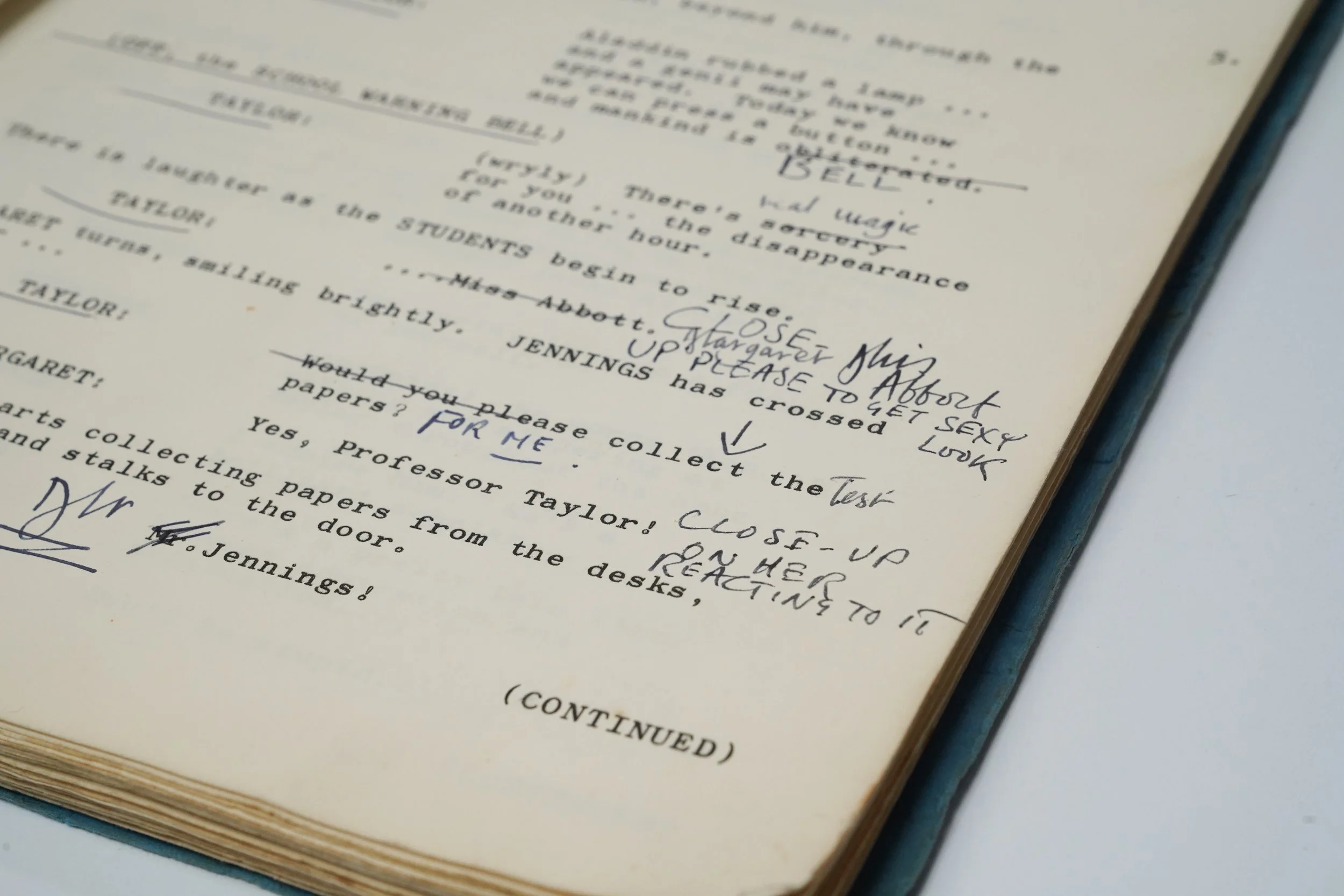
PETER WYNGARDE’S WORKING SCRIPT FOR NIGHT OF THE EAGLE (1962), WITH HIS OWNERSHIP SIGNATURES TO FRONT WRAPPER AND TITLE PAGE. HEAVILY ANNOTATED, REVISED AND UNDERLINED BY WYNGARDE ON EVERY PAGE, AND ON ALMOST EVERY BLANK. TYPED CALL SHEET LAID IN, WITH HOLOGRAPH NOTES TO REVERSE. Adapted from Fritz Lieber’s 1943 novel Conjure Wife by Twilight Zone veterans Richard Matheson and Charles Beaumont, and crime writer George Baxt.
Directed by Sidney Hayers and starring Peter Wyngarde, Janet Blair and Margaret Johnson, the audience for Night of the Eagle (1962) took a while to build. Wyngarde, his flatmate Alan Bates, and their friend John Schlesinger went to an opening day screening in London, only to find they had the cinema pretty much to themselves. But the stock of Night of the Eagle has risen steadily since that inauspicious beginning. Snappily told and imaginatively shot, this psychological thriller about witchcraft in academia sits between Jacques Tourneur’s Night of the Demon (1957) and Roman Polanski’s Rosemary’s Baby (1968) in a trio of films which bring the satanic into the everyday, without a cauldron or broomstick in sight.
Biographical details about Peter Wyngarde, the film’s star, are both plentiful and sketchy. His real name was Cyril Goldbert. According to his death certificate he was born in 1927, but official documents issued to him during his lifetime bear birth dates ranging from 1924 to 1937. (Wyngarde himself claimed not to know his true age.) He was born in Marseille (or possibly Singapore) to Henry Goldbert, a Ukraine-born merchant seaman -- and not, as Wyngarde claimed, a British diplomat called Henry Wyngarde who appears never to have existed. Wyngarde’s mother Margharita Goldbert, née Ahin, was probably born in Singapore, although Wyngarde always insisted she was French. In 1943 he was interned in Lunghua Camp in Shanghai. J.G. Ballard was a fellow internee there, and knew Wyngarde; for some reason Wyngarde always denied knowing him.
Through the 1950s Wyngarde enjoyed a steady career on British television before being cast as Peter Quint in The Innocents (1961), Jack Cardiff’s classic adaptation of Henry James’s ghost story The Turn of the Screw (1891). The film’s success brought more film offers -- among them Night of the Eagle. In an interview recorded in 2014, Wyngarde admitted that at first he was unimpressed by the script (’very much in the not-as-good-as-Hammer category’) but decided to do it for a fee of £5,000 7s 6d -- the price of the Bristol 405 sports car he’d set his heart on owning. After Night of the Eagle Wyngarde’s star continued to rise, and two TV series, Department S (1969-70) and Jason King (1971-72), made him a household name, the handlebar moustache and bouffant hairstyles he sported in the shows linking him forever to 70s high fashion, and even higher camp. In his later years he gradually disappeared from public view, and he died in 2018 at the age of ninety. (Probably.)
Wyngarde’s copy of the screenplay of Night of the Eagle, heavily amended and annotated, speaks to his close working relationship with the film’s director Sidney Hayers. Both men thought the story best told by keeping explicitly ‘hocus-pocus’ elements to a minimum, and many of the textual changes here reflect this. Wyngarde has also added a long list of comments, queries to raise, possible moves and props and costume notes to almost every page featuring his character, as well as thoughts on many other scenes in which he does not appear. He even makes occasional and usually self-interested suggestions for camera shots: in the margin of the film’s opening scene, for example, in which Wyngarde’s college lecturer is addressing his students, Wyngarde has written ‘CLOSE-UP PLEASE TO GET SEXY LOOK.’ (Sidney Hayers didn’t oblige.)
The call sheet laid in to the script is dated 4 November 1961, when some of the college interior scenes were shot. True to form, Wyngarde has used the reverse blank to make some more notes and suggestions on scenes still to be shot.
A remarkable script from the production floor of a cult classic. Hitherto unseen, and the working copy one of the most intriguing and perplexing figures of 1970s British popular culture.
The Acid Test/Grateful Dead
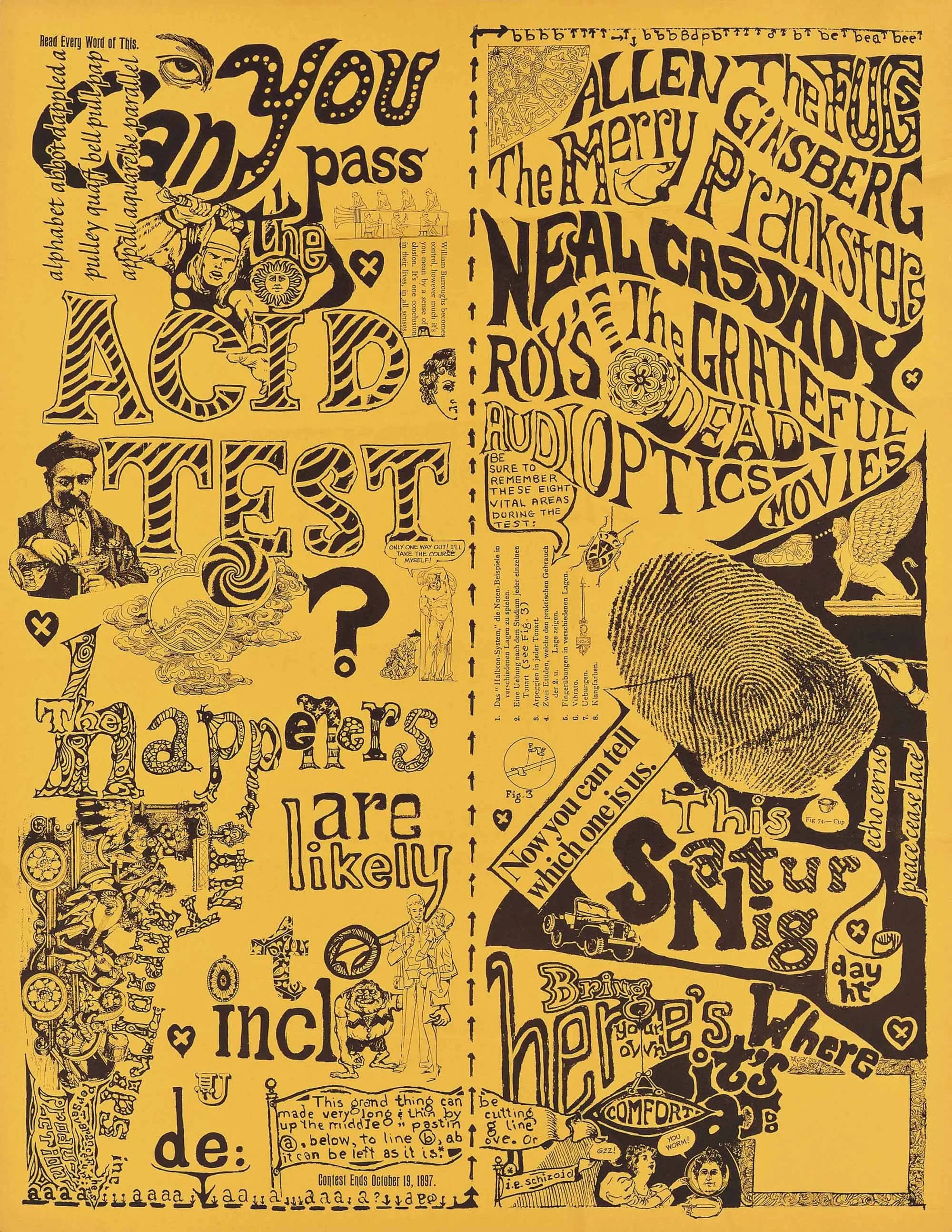
A rare Can you pass the Acid Test? Tour blank poster, goldenrod variant, circa December 1965, designed by Paul Foster. 22x17in. (56x43cm.)
The Acid Tests were a series of parties set up around the San Francisco area in 1965-66 by author Ken Kesey and the Merry Pranksters centred around the use of the psychedelic drug LSD, along with light shows, film projection and improvised music, and were instrumental in the spread of the psychedelic movement across California and the birth of the Grateful Dead. Jerry Garcia explained The Acid Test was the prototype for our whole basic trip... We were lucky to have a little moment in history when LSD was still legal and we could experiment with drugs like we were experimenting with music. It wasn't a gig, it was the Acid Test... Anything was O.K.. It was farout beautiful magic. We had no reputation and nobody was paying to see us or anything like that. We weren't the headliners, the event was. Anything that happened was part of it. There was always the option to not play. ...The freedom is what I loved about it.
The first known use of this poster was for the Acid Test at Muir Beach, 11th December, 1965, printed on the same goldenrod stock with Muir Beach in the tour blank. Only one is known to have survived, originally owned by Ken Kesey. White variants have turned up for the Test at the Big Beat, Palo Alto on 18th December, 1965, and both white and blue variants from the Fillmore Acid Test on 8th January, 1966, the last known use of this design. The poster gives the instructions This grand thing can be made very long & thin by cutting up the middle... so that one half could be placed above the other to paste on telephone poles or streetlights. It is believed that the goldenrod stock were stashed away for some reason, as a few dozen tour blanks on goldenrod are known to have survived.
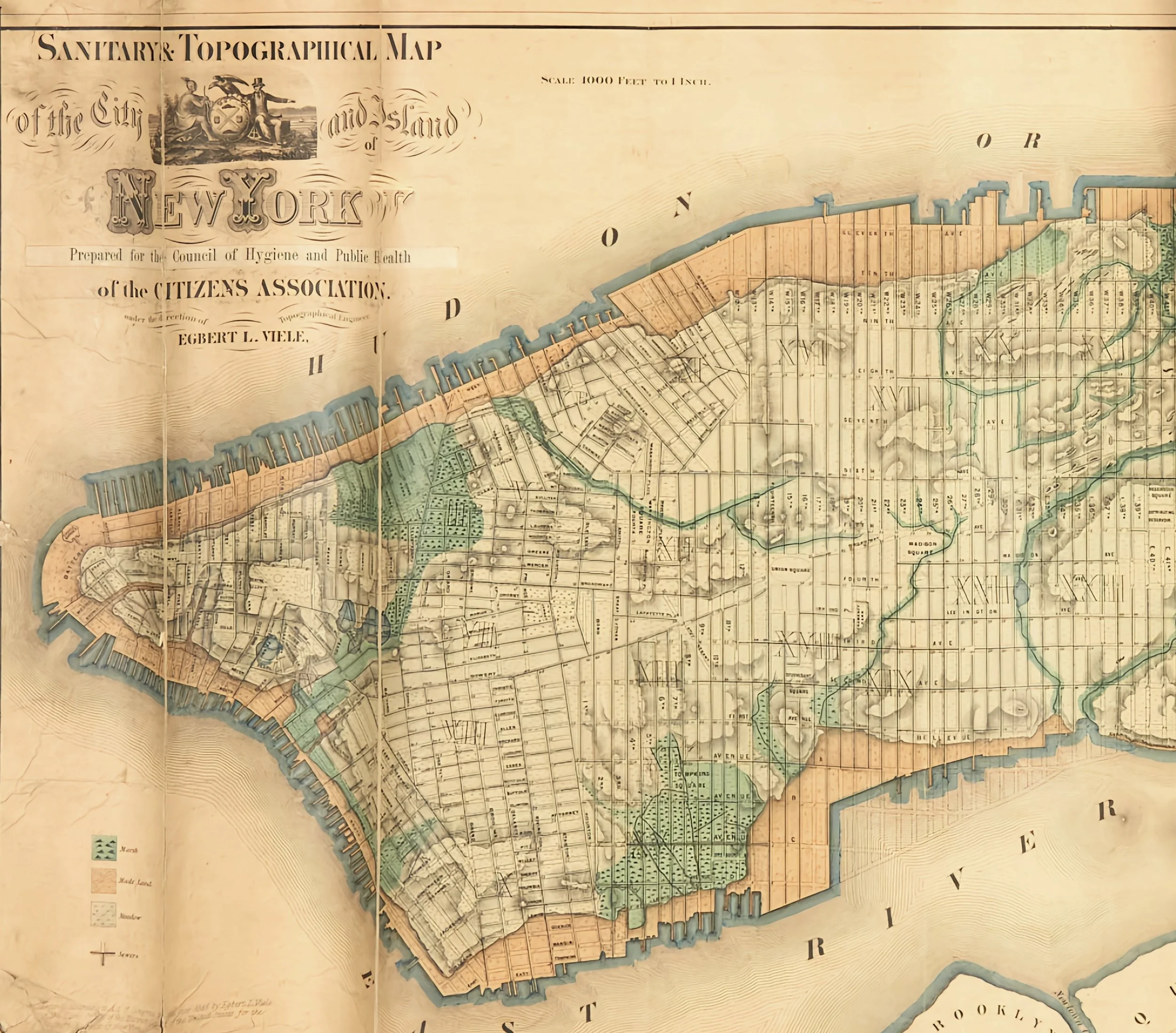
A Landmark in American Cartography.
One of the scarcest and most important maps of Manhattan ever produced.
New York: Egbert L. Viele, 1865. This state with the printed paper slip pasted down to the title correcting an error, originally issued accompanying the "Report of the Council of Hygiene and Public Health of the Citizen's Association of New York upon the Sanitary Condition of the City," New York: D. Appleton & Co., 1865 (per Stokes, Iconography of Manhattan Island, Vol. III, p. 778). Measures 19 1/4 x 64 1/4 inches (48.75 x 163 cm); hand-colored lithographed map on two sheets joined, linen-backed with a pink cloth border.
One of the most remarkable maps ever produced of Manhattan: a large-scale (1000 feet=1 inch) work providing a virtual cartographic x-ray of Manhattan Island, recreating on paper its pre-development topography, contours, and hydrology. “It delineates the original watercourses, streams (underground and surface), meadows, marshes, ponds, ditches, canals, and the shoreline before landfill expanded the city’s boundaries” (Augustyn/ Cohen). So accurate was the map in achieving its purpose that it is used to this day by construction companies and public utilities to ascertain where water might still be flowing underground. Martin Febesh (cited in Augustyn/ Cohen), whose company laid the foundation of the Citicorp Centre, said of the map that he had found it “…accurate within feet.” Finally, in 1874, he enlarged the map with corrections, changes and additions, and published it separately... Twenty years of surveying and studying went into perfecting this great map..." (Paul E. Cohen and Robert T. Augustyn, Manhattan in Maps, New York, 1997, pp.136-139).
The current map is an expansion on Viele's first sanitation map of the city, which was published in 1859 and showed only the lower half of the island. In this 1865 edition, issued to accompany his Report of the Council of Hygiene and Public Health of the Citizen's Association of New York upon the Sanitary Condition of the City, Viele maps the whole island for the first time. This map clearly delineates the city's underground rivers, ponds, canals, marshland, meadows, and sewers, as well as infilled shorelines. Viele's work on underground waterways and sanitation came at a time of great concern over disease in the city, namely cholera and malaria, which he believed were caused by an excess of moisture in the ground. He proposed that all sewage and drainage should follow the island's natural waterways, and that "the original water courses should again be permitted to have their deep and free outlets to tide water" (Manhattan in Maps). Despite Viele's intentions for his map, it found both unforeseen longevity and unrelated usefulness in the decades that followed. Its accuracy in mapping the city's waterways made it an invaluable resource to the architects, engineers, and builders constructing a rapidly growing city throughout the twentieth century. For example, it was referenced during the building of the Empire State Building, Stuyvesant Town, and United Nations Plaza.
This is one of the most desirable maps of New York City and is scarce in any condition.
Contact Us