
 Image 1 of 1
[dir. PREMINGER, Otto] [URIS, Leon] TRUMBO, Dalton
Exodus
London: Carlyle-Alpina, S.A.: 1960
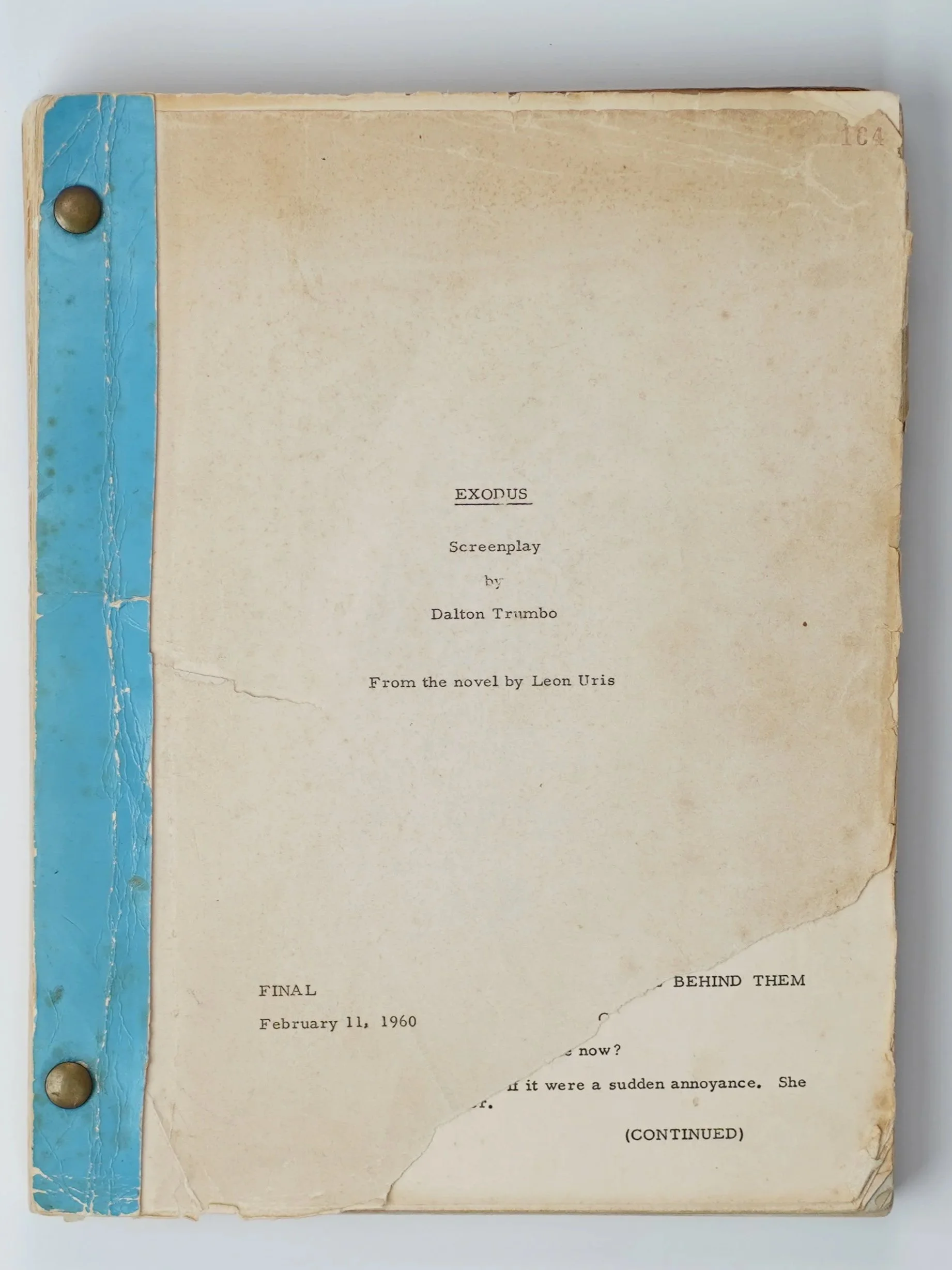
246 variegated mimeographed pp., bound in blue stiff paper wrappers secured with two split pins to left edge. Lacking front wrapper, paper loss to title page at lower right corner (losing the Carlyle-Alpina address), internally complete. Pink and blue revision pages bound in. Very good.
Adapted from Leon Uris’ 1958 novel about the founding of the State of Israel, Exodus (1960), directed by Otto Preminger and starring Paul Newman, Eve Marie Saint, Lee J. Cobb and Ralph Richardson, played a significant role in ending the Hollywood blacklist imposed by the House Un-American Activities Committee during the 1940s and 50s. Overseen by Republican Senator Joseph McCarthy and his chief counsel (and Donald Trump’s mentor) Roy Cohn, the blacklist hindered and in many cases destroyed the careers of actors, writers and directors then working in Hollywood who were suspected of Communist sympathies.
Dalton Trumbo, one of the original Hollywood Ten imprisoned for contempt of Congress in 1947 for refusing to answer questions before the HUAC, was openly hired by director Otto Preminger to write the screenplay for Exodus. Trumbo had managed to keep working during the 1950s by writing under pseudonyms — and unbeknownst to either the Academy or the HUAC had won two Oscars in the process. His screenplay for Roman Holiday (1953) was only formally credited to him in 2011; he won the second for The Brave One (1956), written under the pseudonym Robert Rich.
Preminger’s hiring of Trumbo, and his insistence that Trumbo’s name should appear on the film’s credits, marked the beginning of the end of the blacklist, a pernicious chapter in domestic American history.
Among the cast of Exodus is Lee J. Cobb. Cobb had been named as a Communist sympathiser in testimony given to the HUAC,
and was duly subpoenaed. Cobb resisted the HUAC for two years before the strain on his family and his inability to work broke
him. He testified in 1953, giving HUAC the names of twenty US Communist Party members. During the blacklist writers could continue to work under a pseudonym, but actors could not. Preminger wanted both Trumbo and Cobb to work on Exodus; what the two men said to each other is not recorded.
A screenplay with a significance beyond its primary function, defiantly credited to Dalton Trumbo on the title page.
[dir. PREMINGER, Otto] [URIS, Leon] TRUMBO, Dalton
Exodus
London: Carlyle-Alpina, S.A.: 1960
246 variegated mimeographed pp., bound in blue stiff paper wrappers secured with two split pins to left edge. Lacking front wrapper, paper loss to title page at lower right corner (losing the Carlyle-Alpina address), internally complete. Pink and blue revision pages bound in. Very good.
Adapted from Leon Uris’ 1958 novel about the founding of the State of Israel, Exodus (1960), directed by Otto Preminger and starring Paul Newman, Eve Marie Saint, Lee J. Cobb and Ralph Richardson, played a significant role in ending the Hollywood blacklist imposed by the House Un-American Activities Committee during the 1940s and 50s. Overseen by Republican Senator Joseph McCarthy and his chief counsel (and Donald Trump’s mentor) Roy Cohn, the blacklist hindered and in many cases destroyed the careers of actors, writers and directors then working in Hollywood who were suspected of Communist sympathies.
Dalton Trumbo, one of the original Hollywood Ten imprisoned for contempt of Congress in 1947 for refusing to answer questions before the HUAC, was openly hired by director Otto Preminger to write the screenplay for Exodus. Trumbo had managed to keep working during the 1950s by writing under pseudonyms — and unbeknownst to either the Academy or the HUAC had won two Oscars in the process. His screenplay for Roman Holiday (1953) was only formally credited to him in 2011; he won the second for The Brave One (1956), written under the pseudonym Robert Rich.
Preminger’s hiring of Trumbo, and his insistence that Trumbo’s name should appear on the film’s credits, marked the beginning of the end of the blacklist, a pernicious chapter in domestic American history.
Among the cast of Exodus is Lee J. Cobb. Cobb had been named as a Communist sympathiser in testimony given to the HUAC,
and was duly subpoenaed. Cobb resisted the HUAC for two years before the strain on his family and his inability to work broke
him. He testified in 1953, giving HUAC the names of twenty US Communist Party members. During the blacklist writers could continue to work under a pseudonym, but actors could not. Preminger wanted both Trumbo and Cobb to work on Exodus; what the two men said to each other is not recorded.
A screenplay with a significance beyond its primary function, defiantly credited to Dalton Trumbo on the title page.