
 Image 1 of 2
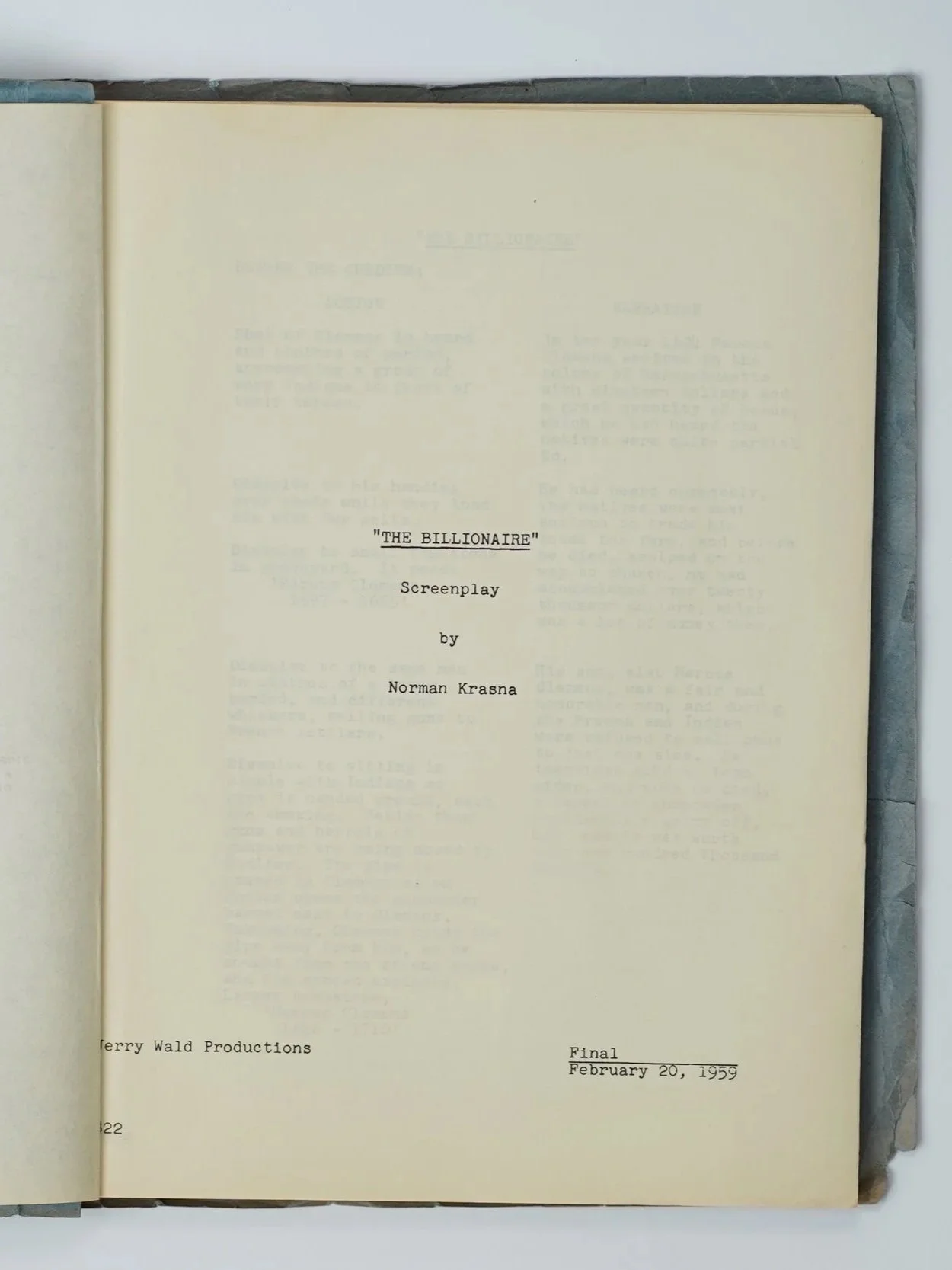 Image 2 of 2
[dir. CUKOR, George] [MILLER, Arthur; KANTER, Hal] KRASNA, Norman
Let’s Make Love (The Billionaire)
Los Angeles: Jerry Wald Productions/Twentieth Century Fox, 1959
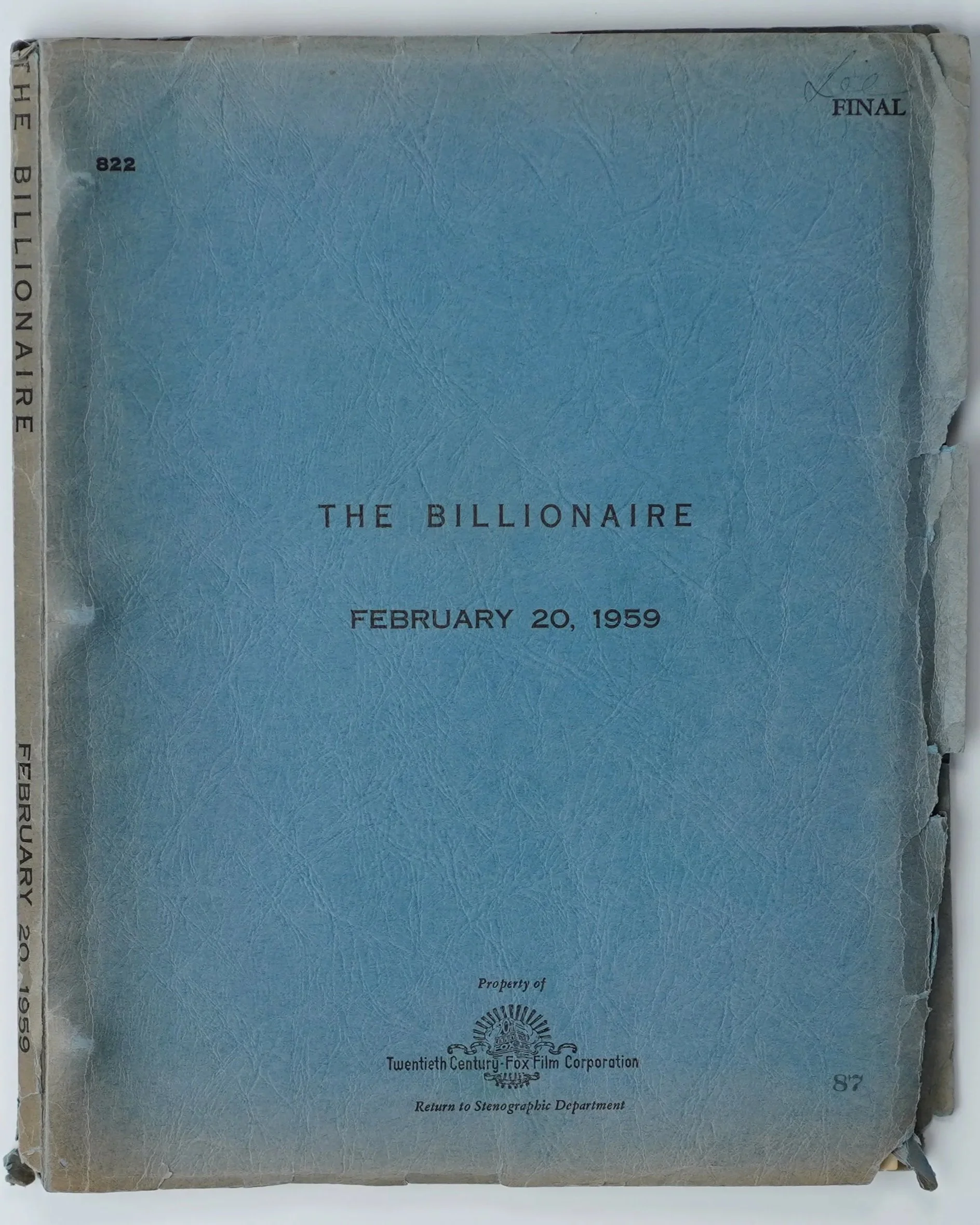
145 mimeographed pp., bound in blue stiff paper wrappers secured with three split pins to left edge. Preliminary loan leaf stamped ’87’ bound in, lower right portion (possibly the loan form) neatly cut away. Titled in black to front panel and spine, printed ‘FINAL’ and ‘FEBRUARY 20 1959’ to front panel and title page. Printed 20th Century-Fox logo to front wrapper. Occasional holograph markings to text. Wear to oversize wrappers, but contents very well preserved.
FINAL DRAFT SCREENPLAY OF MARILYN MONROE’S PENULTIMATE FILM. ACTING COACH LOIS AUER’S COPY, WITH OCCASIONAL ANNOTATIONS IN AN UNKNOWN HAND.
Let’s Make Love (1960) was Marilyn Monroe’s penultimate film, released between Some Like It Hot (1959) and The Misfits (1961). (Something’s Got To Give (1962) remained unfinished at the time of her death.) After Some Like It Hot Monroe had wanted to go straight to work on The Misfits, written by her husband Arthur Miller, but a contract signed with Twentieth Century-Fox in 1955 obliged her to make Let’s Make Love first.
Monroe’s co-star in Let’s Make Love was Yves Montand. Montand was not the first choice for the role (Gregory Peck had dropped out) and his English was still poor and very heavily accented when he arrived in the US with his wife Simone Signoret. Although Monroe, Montand and their spouses got on famously and were soon inseparable, they were aware from the start that they
were bonding in adversity. Miller did what he could to polish the screenplay, and Montand did what he could to improve his English, but Monroe could do nothing about the unhappiness she felt at having to be there at all. When filming began in January 1960 Miller and Signoret flew home, leaving Monroe and Montand to bond still further. Their brief affair plunged Monroe into further turmoil. Director George Cukor did what he could to help: ‘She was very sweet, but I had no real communication with her at all. You couldn’t get at her [...] As a director I really had very little influence on her. All I could do was make a climate that was agreeable for her. Every day was an agony of struggle for her, just to get there.’ Monroe’s marriage, already in trouble, was now doomed, and she and Miller were divorced shortly after filming The Misfits. In her autobiography Nostalgia Isn’t What It Used To Be (Weidenfeld & Nicholson, 1978) Simone Signoret wrote: ‘She will never know how much I didn’t hate her, and how I understood that story, which only concerned the four of us, although it seemed to obsess the whole world.’
Monroe thought Let’s Make Love her worst film; Montand did not get the Hollywood career he’d hoped for, and the couple’s affair ended with his return to Europe. And the film itself? It’s bland, and its tone is uncertain, but you’ll have seen worse. What lingers above all is the melancholy of the backstory.
This copy of the screenplay comes from the estate of the acting coach (but not Marilyn Monroe’s acting coach) Lois Auer. The screenplay carries the name ‘Lee’ in faint holograph pencil to the right corner of the front wrapper, which may indicate it was once in the possession of Monroe’s own acting coach Lee Strasberg, father of The Method, and the person to whom Monroe left all her possessions after her death.
[dir. CUKOR, George] [MILLER, Arthur; KANTER, Hal] KRASNA, Norman
Let’s Make Love (The Billionaire)
Los Angeles: Jerry Wald Productions/Twentieth Century Fox, 1959
145 mimeographed pp., bound in blue stiff paper wrappers secured with three split pins to left edge. Preliminary loan leaf stamped ’87’ bound in, lower right portion (possibly the loan form) neatly cut away. Titled in black to front panel and spine, printed ‘FINAL’ and ‘FEBRUARY 20 1959’ to front panel and title page. Printed 20th Century-Fox logo to front wrapper. Occasional holograph markings to text. Wear to oversize wrappers, but contents very well preserved.
FINAL DRAFT SCREENPLAY OF MARILYN MONROE’S PENULTIMATE FILM. ACTING COACH LOIS AUER’S COPY, WITH OCCASIONAL ANNOTATIONS IN AN UNKNOWN HAND.
Let’s Make Love (1960) was Marilyn Monroe’s penultimate film, released between Some Like It Hot (1959) and The Misfits (1961). (Something’s Got To Give (1962) remained unfinished at the time of her death.) After Some Like It Hot Monroe had wanted to go straight to work on The Misfits, written by her husband Arthur Miller, but a contract signed with Twentieth Century-Fox in 1955 obliged her to make Let’s Make Love first.
Monroe’s co-star in Let’s Make Love was Yves Montand. Montand was not the first choice for the role (Gregory Peck had dropped out) and his English was still poor and very heavily accented when he arrived in the US with his wife Simone Signoret. Although Monroe, Montand and their spouses got on famously and were soon inseparable, they were aware from the start that they
were bonding in adversity. Miller did what he could to polish the screenplay, and Montand did what he could to improve his English, but Monroe could do nothing about the unhappiness she felt at having to be there at all. When filming began in January 1960 Miller and Signoret flew home, leaving Monroe and Montand to bond still further. Their brief affair plunged Monroe into further turmoil. Director George Cukor did what he could to help: ‘She was very sweet, but I had no real communication with her at all. You couldn’t get at her [...] As a director I really had very little influence on her. All I could do was make a climate that was agreeable for her. Every day was an agony of struggle for her, just to get there.’ Monroe’s marriage, already in trouble, was now doomed, and she and Miller were divorced shortly after filming The Misfits. In her autobiography Nostalgia Isn’t What It Used To Be (Weidenfeld & Nicholson, 1978) Simone Signoret wrote: ‘She will never know how much I didn’t hate her, and how I understood that story, which only concerned the four of us, although it seemed to obsess the whole world.’
Monroe thought Let’s Make Love her worst film; Montand did not get the Hollywood career he’d hoped for, and the couple’s affair ended with his return to Europe. And the film itself? It’s bland, and its tone is uncertain, but you’ll have seen worse. What lingers above all is the melancholy of the backstory.
This copy of the screenplay comes from the estate of the acting coach (but not Marilyn Monroe’s acting coach) Lois Auer. The screenplay carries the name ‘Lee’ in faint holograph pencil to the right corner of the front wrapper, which may indicate it was once in the possession of Monroe’s own acting coach Lee Strasberg, father of The Method, and the person to whom Monroe left all her possessions after her death.