
 Image 1 of 4
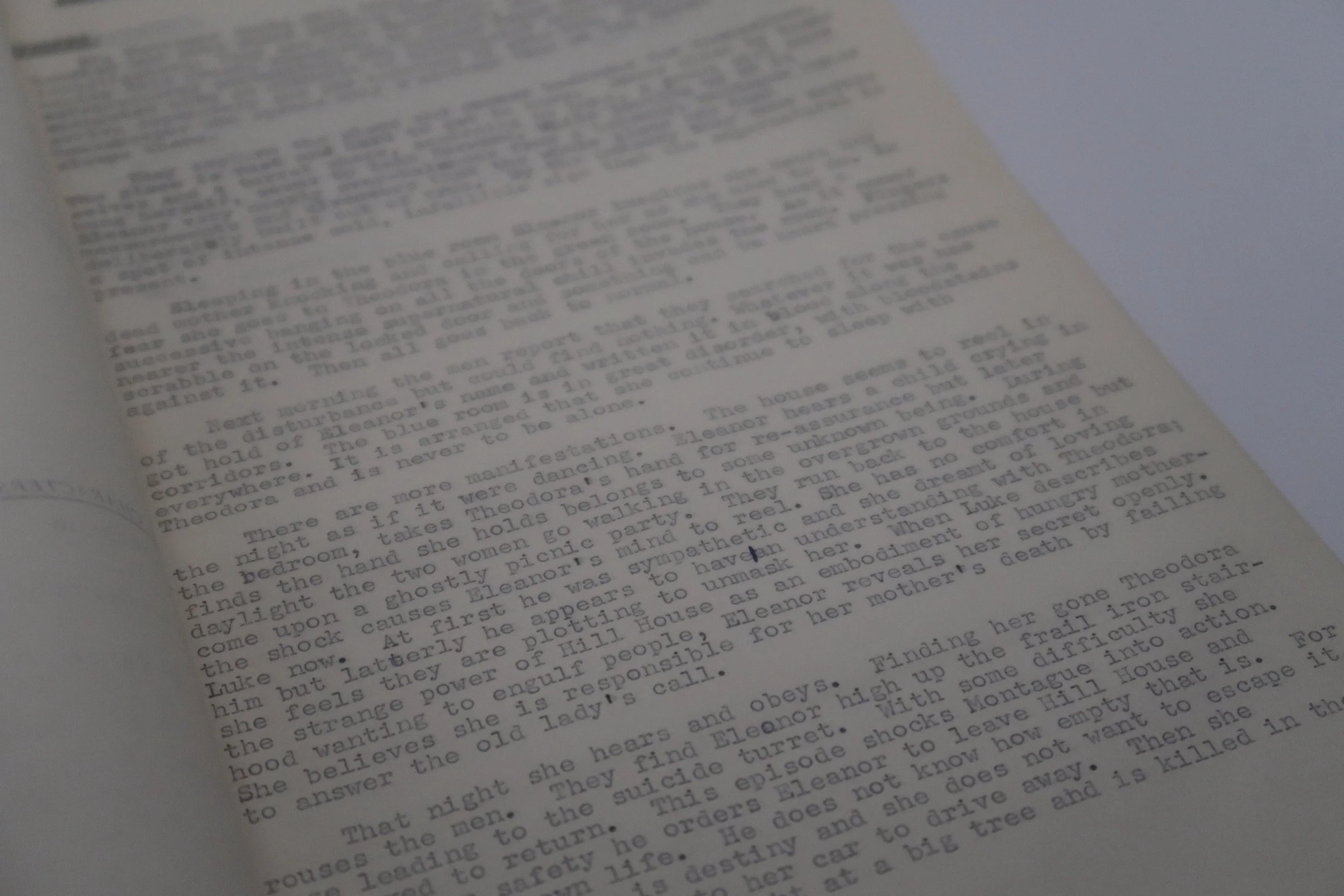 Image 2 of 4
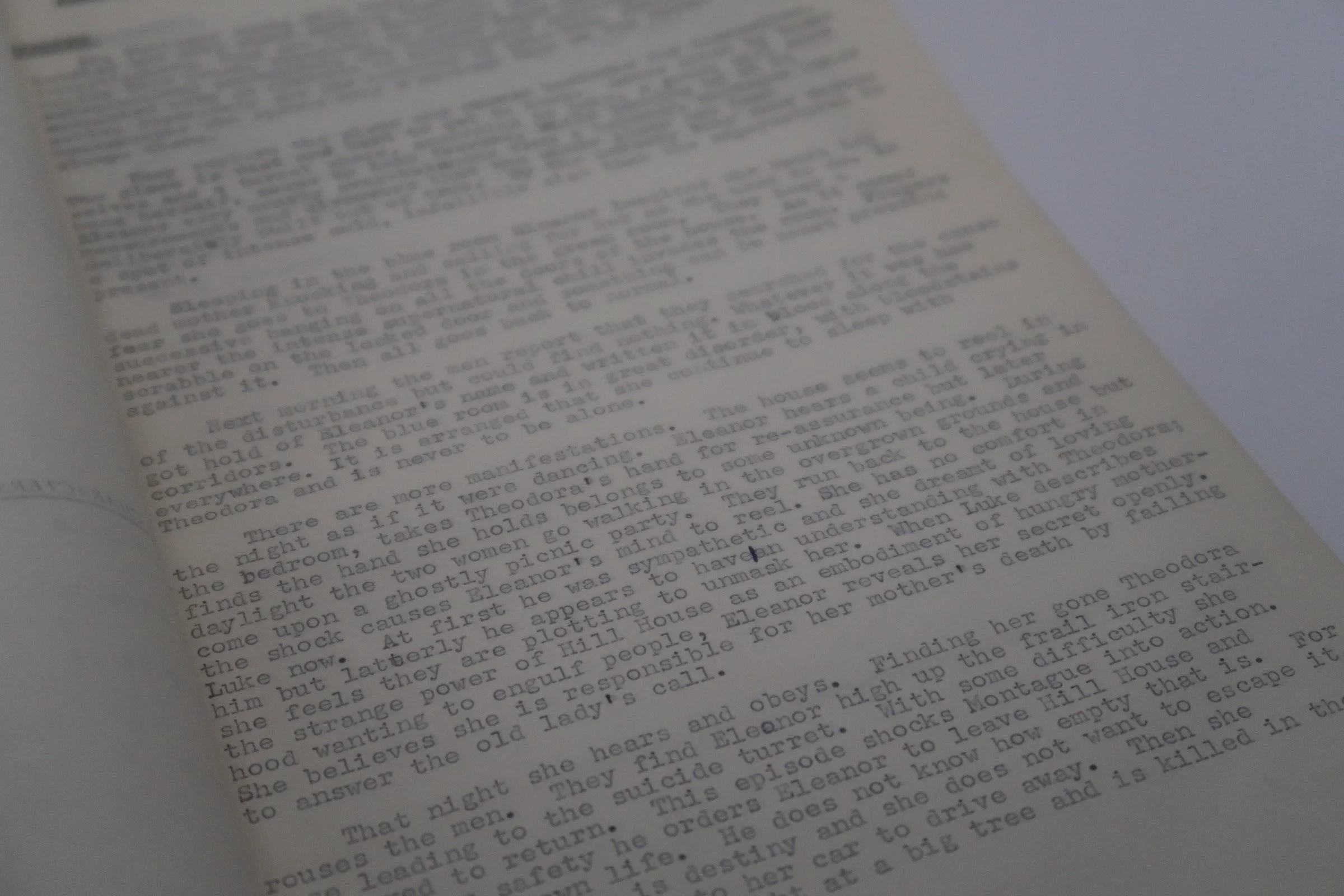 Image 3 of 4
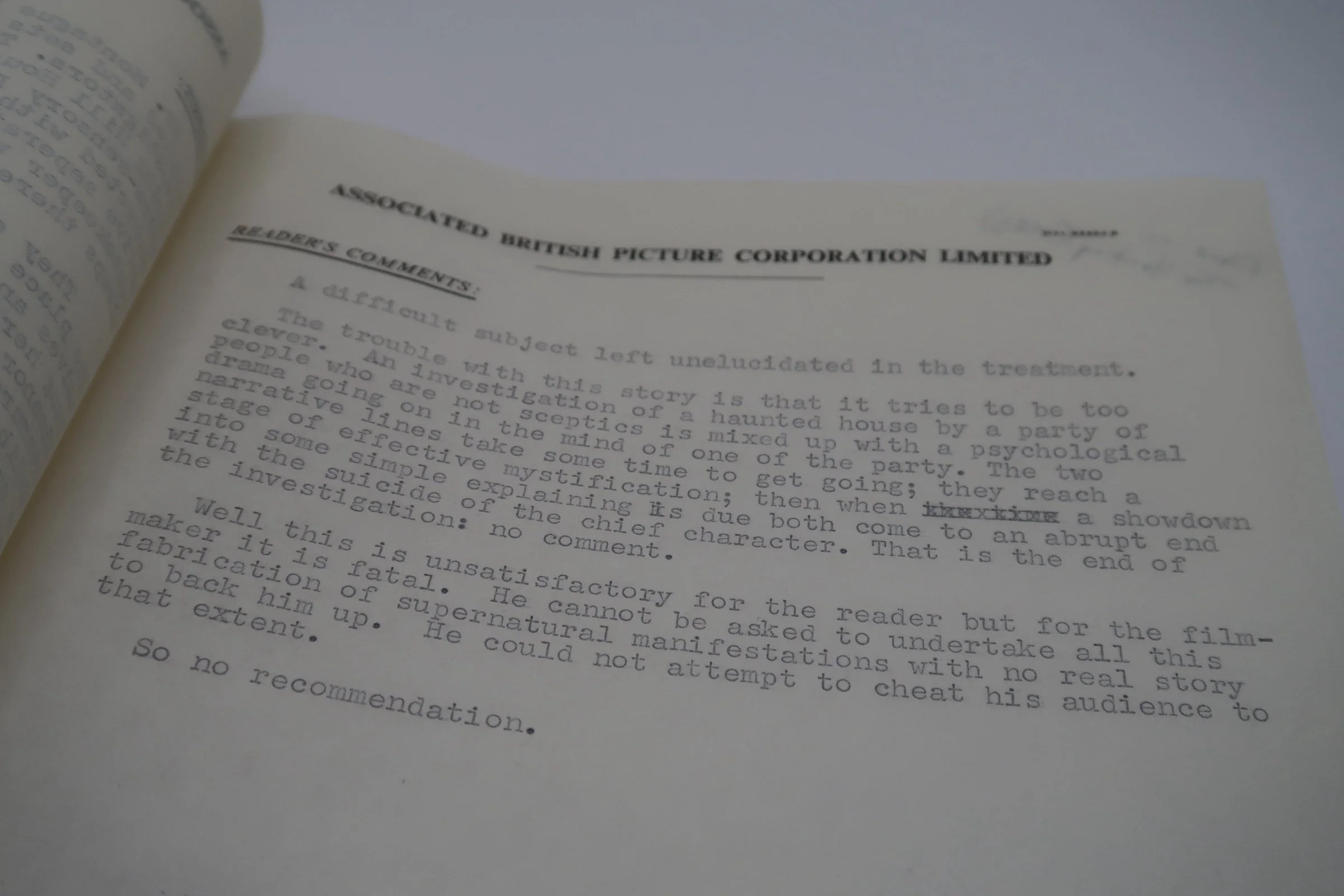 Image 4 of 4
The Haunting Of Hill House
‘…The trouble with this story is that it tries to be too clever”
[JACKSON, Shirley] [Elstree Studios] COMMON, Jack The Haunting Of Hill House: ABPC readers’ report, assessing the novel’s potential for screen adaptation
N.p. [Elstree]: N.p. [ABPC], 1960.
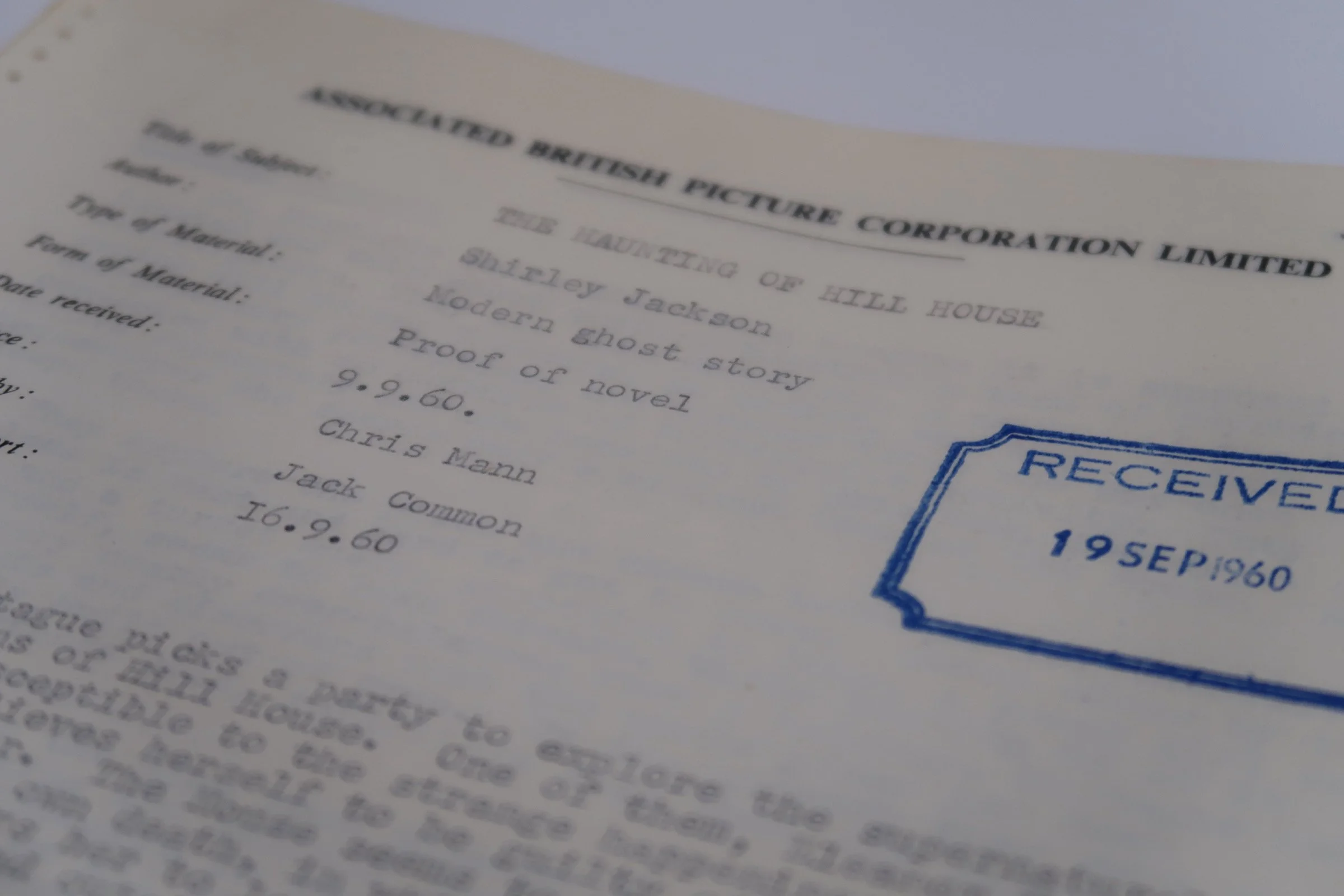
3pp. typed report on rectos only, receipt stamps to the first page of 19th September 1960. Perforations down left edge from office binding. Very well preserved.
ELSTREE STUDIOS’ UNFAVOURABLE READER’S REPORT OF THE HAUNTING OF HILL HOUSE. WRITTEN THREE YEARS BEFORE IT WAS FIRST ADAPTED BY ANOTHER STUDIO AND DIRECTED BY ROBERT WISE. THE READER, NOTED BRITISH AUTHOR JACK COMMON (CLOSE FRIEND OF ORWELL) LAMBASTS THE GREAT AMERICAN GHOST STORY AS ONE WITH “NO REAL STORY TO BACK UP.”
Located in a corner block on the Elstree lot opposite the main administration building, the job of Associated British Picture Corporation’s Reading Department was to identify potential film projects for the studio. Most of the material considered by the studio came in the form of new novels, either selected by the readers themselves or submitted to ABPC by their authors’ literary agents. Unsolicited screenplays were also read, as were older titles by authors whose work had enjoyed recent screen success and whose back catalogues might contain other ideas for films. Readers also attended new plays to assess their filmic possibilities.
All reports were written and presented in strict accordance with ABPC’s house style. The first page would carry author, title and genre, how and by whom the work had been submitted, and a date stamp indicating when it had been received. The writer of the report would also usually be identified, either by name or initials (the reader in this case was R. Groves). A brief outline would be given (’SUMMARY’), and there would then follow a long and detailed synopsis (’STORY’). More of a potted version of the work under consideration rather than a mere outline of the story, the Story would be sufficiently thorough to provide those reading it with a full working knowledge of the material, removing the need for them to read the full book themselves. Finally, the reader would give their verdict on the work and detailed reasons for their decision (’COMMENT’). In almost all cases, the verdict would be ‘Not Recommended’; occasionally, the reader would call for a second opinion; and very occasionally, the reader would recommend fast-tracking material to studio heads for their immediate consideration. The system was far-reaching, diligent and rigorous. It was also often very wrong.
The reader’s report for Elstree notes that the script was submitted as a “Proof of a novel” sent by ‘Chris Mann’, evidently someone involved in publishing the UK first edition of the novel and authorised to share a proof for consideration of adaptation. The report was submitted on September 16th 1960.
The Readers’ Comments are overwhelmingly negative with the reader not liking Jackson’s style of writing or the plot and narrative of the story:
“A difficult subject left unelucidated in the treatment.
The trouble with this story is that it tries to be too clever. An investigation of haunted house by a party of people who are not sceptics is mixed up with a psychological drama going on in the mind of one of the party. The two narrative lines take some time to get going; they reach a stage of effective mystification; then when a showdown into some simple explaining is due both come to an abrupt end with the suicide of the chief character. That is the end of the investigation: no comment.
Well this is unsatisfactory for the reader but for the film-maker it is fatal. He cannot be asked to undertake all this fabrication of supernatural manifestations with no real story to back him up. He could not attempt to cheat his audience to that extent. So no recommendation.”
ABPC ultimately agreed with the reader and did not attempt to secure the rights; it would go on to be adapted for the first time three years later, with Robert Wise directing. The film was released on 18 September 1963. In 2010, The Guardian newspaper ranked it as the 13th-best horror film of all time. Director Martin Scorsese placed The Haunting first on his list of the 11 scariest horror films of all time. The book would be adapted again for film in 1999 and for a Netflix series in 2018.
Stephen King, in his book Danse Macabre (1981), a non-fiction review of the horror genre, lists The Haunting of Hill House as one of the finest horror novels of the late 20th century and provides a lengthy review. Sophie Missing in the Guardian wrote, "Jackson treats her material – which could be reduced to penny dreadful stuff in less deft hands – with great skill and subtlety. […] The horror inherent in the novel does not lie in Hill House (monstrous though it is) or the events that take place within it, but in the unexplored recesses of its characters' – and its readers' – minds. This is perhaps why it remains the definitive haunted house story."
Over more than a century, the archives of the various film production companies based at Elstree since 1914 have been variously dispersed, destroyed or lost. A unique and hitherto unknown document from the surviving ABPC reader reports, never before offered for sale, and unseen since its composition over sixty years ago.
‘…The trouble with this story is that it tries to be too clever”
[JACKSON, Shirley] [Elstree Studios] COMMON, Jack The Haunting Of Hill House: ABPC readers’ report, assessing the novel’s potential for screen adaptation
N.p. [Elstree]: N.p. [ABPC], 1960.
3pp. typed report on rectos only, receipt stamps to the first page of 19th September 1960. Perforations down left edge from office binding. Very well preserved.
ELSTREE STUDIOS’ UNFAVOURABLE READER’S REPORT OF THE HAUNTING OF HILL HOUSE. WRITTEN THREE YEARS BEFORE IT WAS FIRST ADAPTED BY ANOTHER STUDIO AND DIRECTED BY ROBERT WISE. THE READER, NOTED BRITISH AUTHOR JACK COMMON (CLOSE FRIEND OF ORWELL) LAMBASTS THE GREAT AMERICAN GHOST STORY AS ONE WITH “NO REAL STORY TO BACK UP.”
Located in a corner block on the Elstree lot opposite the main administration building, the job of Associated British Picture Corporation’s Reading Department was to identify potential film projects for the studio. Most of the material considered by the studio came in the form of new novels, either selected by the readers themselves or submitted to ABPC by their authors’ literary agents. Unsolicited screenplays were also read, as were older titles by authors whose work had enjoyed recent screen success and whose back catalogues might contain other ideas for films. Readers also attended new plays to assess their filmic possibilities.
All reports were written and presented in strict accordance with ABPC’s house style. The first page would carry author, title and genre, how and by whom the work had been submitted, and a date stamp indicating when it had been received. The writer of the report would also usually be identified, either by name or initials (the reader in this case was R. Groves). A brief outline would be given (’SUMMARY’), and there would then follow a long and detailed synopsis (’STORY’). More of a potted version of the work under consideration rather than a mere outline of the story, the Story would be sufficiently thorough to provide those reading it with a full working knowledge of the material, removing the need for them to read the full book themselves. Finally, the reader would give their verdict on the work and detailed reasons for their decision (’COMMENT’). In almost all cases, the verdict would be ‘Not Recommended’; occasionally, the reader would call for a second opinion; and very occasionally, the reader would recommend fast-tracking material to studio heads for their immediate consideration. The system was far-reaching, diligent and rigorous. It was also often very wrong.
The reader’s report for Elstree notes that the script was submitted as a “Proof of a novel” sent by ‘Chris Mann’, evidently someone involved in publishing the UK first edition of the novel and authorised to share a proof for consideration of adaptation. The report was submitted on September 16th 1960.
The Readers’ Comments are overwhelmingly negative with the reader not liking Jackson’s style of writing or the plot and narrative of the story:
“A difficult subject left unelucidated in the treatment.
The trouble with this story is that it tries to be too clever. An investigation of haunted house by a party of people who are not sceptics is mixed up with a psychological drama going on in the mind of one of the party. The two narrative lines take some time to get going; they reach a stage of effective mystification; then when a showdown into some simple explaining is due both come to an abrupt end with the suicide of the chief character. That is the end of the investigation: no comment.
Well this is unsatisfactory for the reader but for the film-maker it is fatal. He cannot be asked to undertake all this fabrication of supernatural manifestations with no real story to back him up. He could not attempt to cheat his audience to that extent. So no recommendation.”
ABPC ultimately agreed with the reader and did not attempt to secure the rights; it would go on to be adapted for the first time three years later, with Robert Wise directing. The film was released on 18 September 1963. In 2010, The Guardian newspaper ranked it as the 13th-best horror film of all time. Director Martin Scorsese placed The Haunting first on his list of the 11 scariest horror films of all time. The book would be adapted again for film in 1999 and for a Netflix series in 2018.
Stephen King, in his book Danse Macabre (1981), a non-fiction review of the horror genre, lists The Haunting of Hill House as one of the finest horror novels of the late 20th century and provides a lengthy review. Sophie Missing in the Guardian wrote, "Jackson treats her material – which could be reduced to penny dreadful stuff in less deft hands – with great skill and subtlety. […] The horror inherent in the novel does not lie in Hill House (monstrous though it is) or the events that take place within it, but in the unexplored recesses of its characters' – and its readers' – minds. This is perhaps why it remains the definitive haunted house story."
Over more than a century, the archives of the various film production companies based at Elstree since 1914 have been variously dispersed, destroyed or lost. A unique and hitherto unknown document from the surviving ABPC reader reports, never before offered for sale, and unseen since its composition over sixty years ago.