
 Image 1 of 1
Haiti's Second President Engages With Christian Missionaries
£1,000.00
sold out
Boyer, Jean-Pierre.
A letter signed by the longest-serving Haitian President in his first year in office.
Port-au-Prince: 1818.
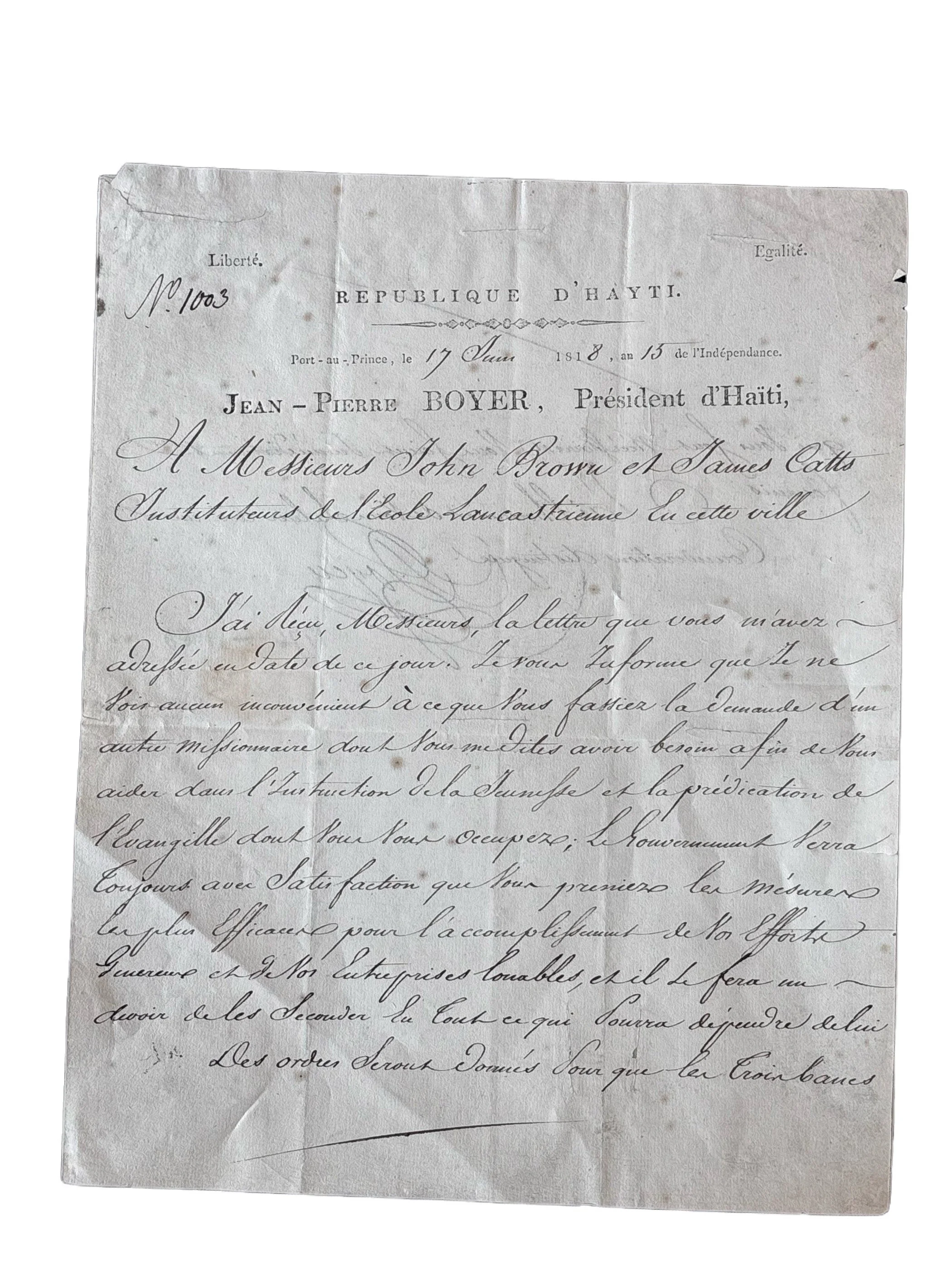
2nd President of Haiti. Letter signed (LS) by President Boyer in his first year as President of the Republic of Haiti on official presidential stationery, sent to John Brown and James Catts. In the letter, Boyer sees no inconvenience in allowing an additional missionary to aid in “the instruction of the reformed faith and preaching the gospel of which you are occupied.”John Brown who was born c1786, began his ministerial career in 1807 at Alnwick, Northumberland. After a few years working in several home circuits, he was selected by the Wesleyan Methodist Missionary Society to start a mission on the island of Hispaniola, in part due to his knowledge of French. He sailed, with James Catts, from Bristol on 22 November 1815 and originally landed in Tobago. After a short time preaching there, they left for Port-au-Prince (arriving on 7th February 1817) but not before they recommended to the Missionary Committee that a mission should be established on Tobago (which it later was). Both Brown and Catts had a difficult time establishing the mission, with Catts concentrating on education (founding a short-lived school) and Brown tending to pastoral matters and most of the preaching. Both of them were taken ill with fever in February 1817, which subsequently hampered their efforts.
An incident in November 1818 brought their mission to a rapid close (and led to no Wesleyan Methodist missionary returning for 9 years). A man, who had been seen in the past worshiping at the Methodist chapel, committed matricide. Some individuals, already antagonistic to the mission, used the opportunity to blame the missionaries for the incident, which in turn resulted in acts of violence against both people and property. The situation escalated to the point where President Boyer recommended that both missionaries leave: Catts going to the Antigua District and Brown returning to England, landing in March 1819. The Methodist community continued in Port-au-Prince (albeit sometimes in adversity) and actually increased in numbers in the following years under purely Haitian-run leadership Letter in Part: I inform you that I see no inconvenience in your making the request of another missionary whom you say you need to help you with the instruction of the Reformed Faith and the preaching of the Gospel with which you are occupied; The Government will always see with satisfaction that you take the most effective measures for the accomplishment of your laudable efforts and enterprises, and it will make it a duty to second them.”Religion in Haiti was fraught in this period with many suspicious of missionaries’ teachings and intentions, with Brown and Catt’s presence in Haiti being a decision made by Boyer’s predecessor, Alexandre Pétion, who was more liberal on religious freedoms. Boyer would eventually ban Haitian Vodou in 1935, but not before he expelled the Wesleyan missionaries later in 1818 after sending this letter.A scarce survivor, showing early Haitian engagement post-independence with Western missionaries.Boyer, Jean-Pierre.
A letter signed by the longest-serving Haitian President in his first year in office.
Port-au-Prince: 1818.
2nd President of Haiti. Letter signed (LS) by President Boyer in his first year as President of the Republic of Haiti on official presidential stationery, sent to John Brown and James Catts. In the letter, Boyer sees no inconvenience in allowing an additional missionary to aid in “the instruction of the reformed faith and preaching the gospel of which you are occupied.”John Brown who was born c1786, began his ministerial career in 1807 at Alnwick, Northumberland. After a few years working in several home circuits, he was selected by the Wesleyan Methodist Missionary Society to start a mission on the island of Hispaniola, in part due to his knowledge of French. He sailed, with James Catts, from Bristol on 22 November 1815 and originally landed in Tobago. After a short time preaching there, they left for Port-au-Prince (arriving on 7th February 1817) but not before they recommended to the Missionary Committee that a mission should be established on Tobago (which it later was). Both Brown and Catts had a difficult time establishing the mission, with Catts concentrating on education (founding a short-lived school) and Brown tending to pastoral matters and most of the preaching. Both of them were taken ill with fever in February 1817, which subsequently hampered their efforts.
An incident in November 1818 brought their mission to a rapid close (and led to no Wesleyan Methodist missionary returning for 9 years). A man, who had been seen in the past worshiping at the Methodist chapel, committed matricide. Some individuals, already antagonistic to the mission, used the opportunity to blame the missionaries for the incident, which in turn resulted in acts of violence against both people and property. The situation escalated to the point where President Boyer recommended that both missionaries leave: Catts going to the Antigua District and Brown returning to England, landing in March 1819. The Methodist community continued in Port-au-Prince (albeit sometimes in adversity) and actually increased in numbers in the following years under purely Haitian-run leadership Letter in Part: I inform you that I see no inconvenience in your making the request of another missionary whom you say you need to help you with the instruction of the Reformed Faith and the preaching of the Gospel with which you are occupied; The Government will always see with satisfaction that you take the most effective measures for the accomplishment of your laudable efforts and enterprises, and it will make it a duty to second them.”Religion in Haiti was fraught in this period with many suspicious of missionaries’ teachings and intentions, with Brown and Catt’s presence in Haiti being a decision made by Boyer’s predecessor, Alexandre Pétion, who was more liberal on religious freedoms. Boyer would eventually ban Haitian Vodou in 1935, but not before he expelled the Wesleyan missionaries later in 1818 after sending this letter.A scarce survivor, showing early Haitian engagement post-independence with Western missionaries.