
 Image 1 of 2
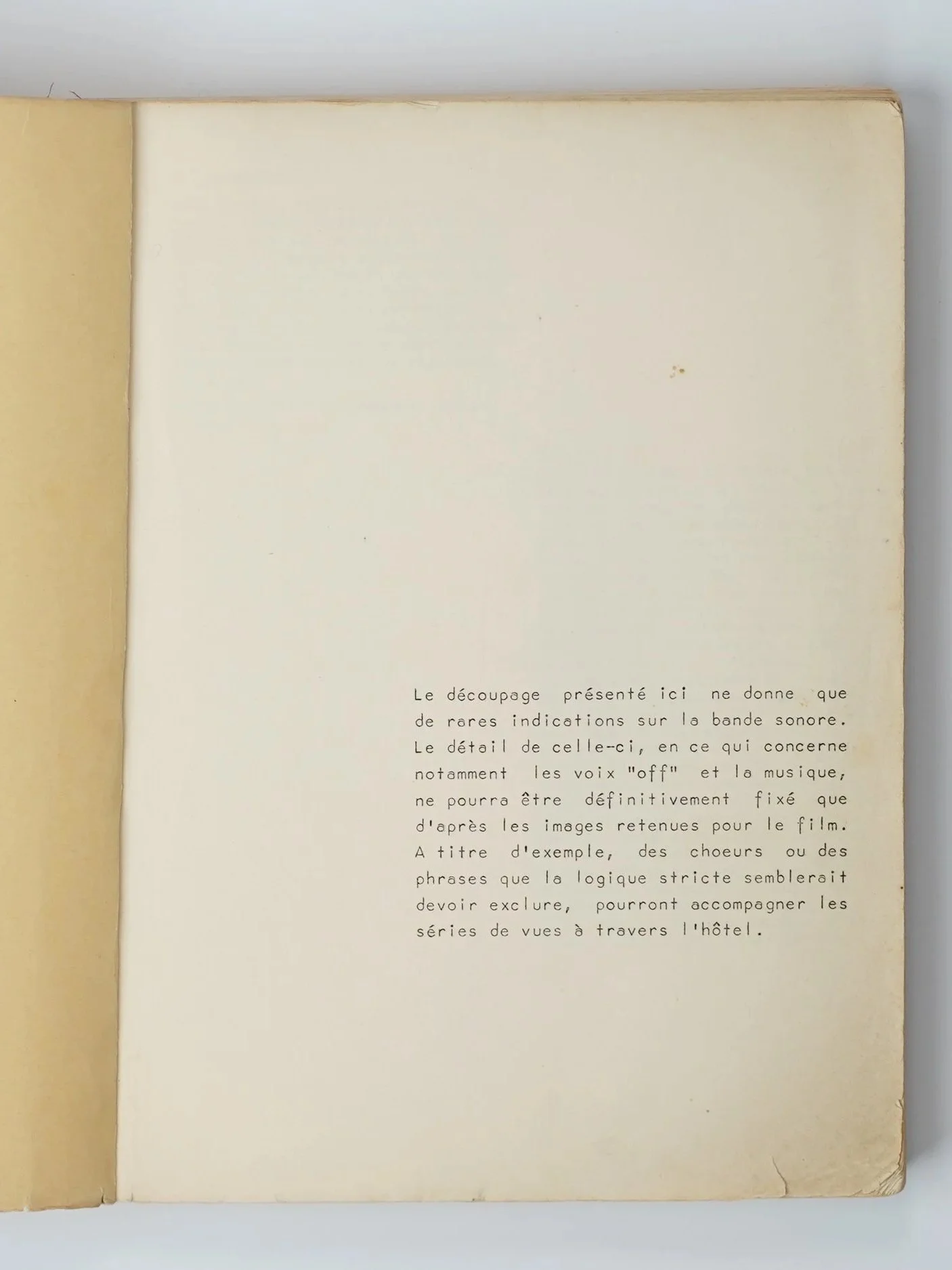 Image 2 of 2
Cornerstone of the French New Wave
[RESNAIS, Alain] ROBBE-GRILLET, Alain L’Année Dernière (Last Year in Marienbad)
Paris: Terra-Films, N.d. [?1960]
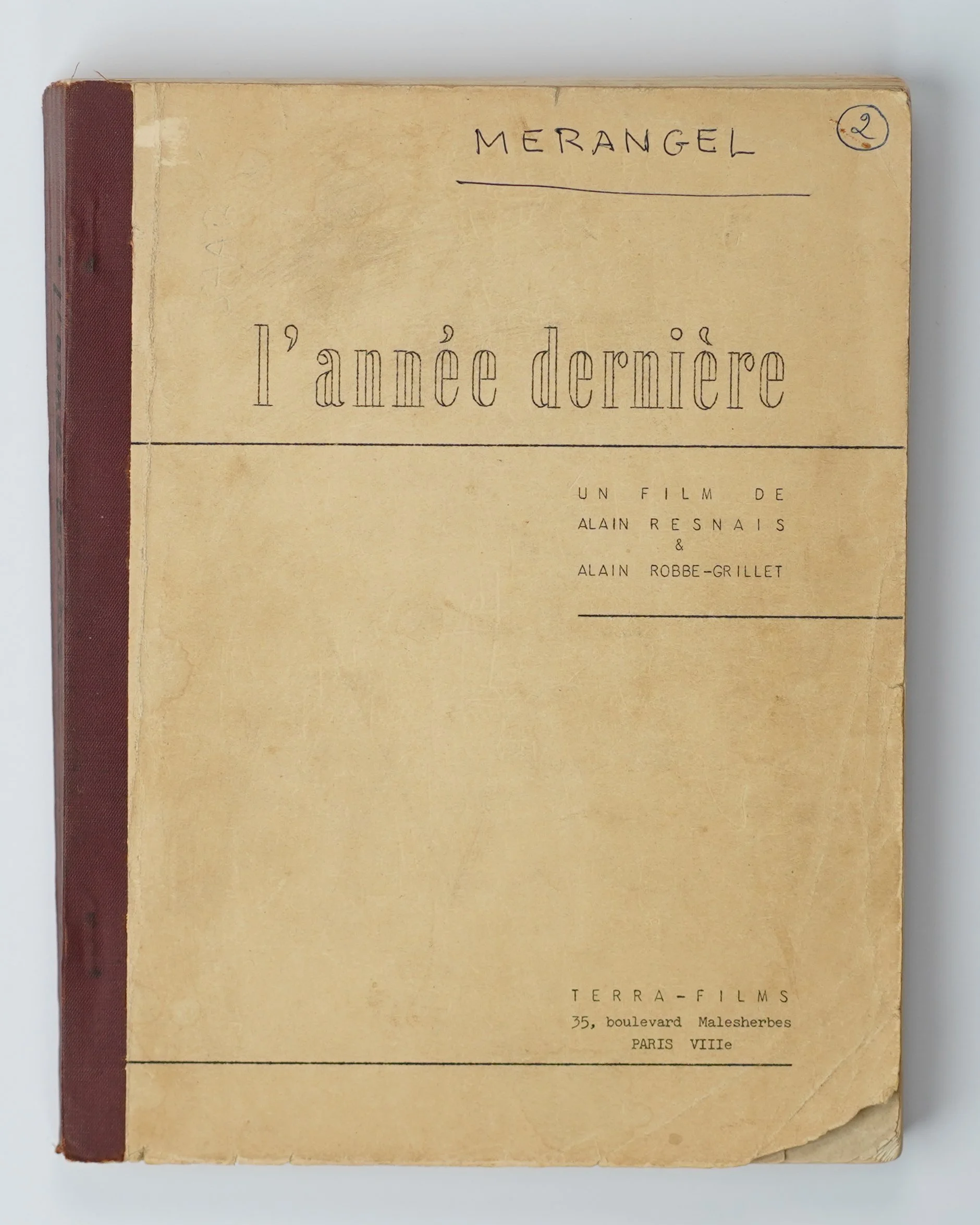
Unpaginated, bound in cream stiff paper wrappers and brown cloth spine. French text. Title (’L’Année Dernière’) inked to lower edge and spine, name ‘MERANGEL’ and an encircled ‘2’ inked to front wrapper. Lower corner of front wrapper missing, wrappers marked and darkened, but a tightly bound, well preserved copy.
ORIGINAL WORKING SCREENPLAY OF L’ANNEE DERNIERE (LAST YEAR AT MARIENBAD). SET DECORATOR CHARLES MERANGEL’S COPY, WITH HIS OWNERSHIP SIGNATURE TO FRONT WRAPPER AND FREQUENT PENCILLED ANNOTATIONS TO TEXT.
Directed by Alain Resnais and starring Georgio Albertazzi, Delphine Seyrig and Sacha Pitöeff. Winner of the Golden Lion at the 1961 Venice Film Festival.
At a palatial country hotel a man meets a woman, and claims to have met her a year before at Frederiksbad, or Karlstadt, or Marienbad, and that they had an affair. The woman denies all knowledge of the man who by now has attracted the attention of a second man, who may or may not be the woman’s husband. None of the characters in this ménage are referred to by name in the film’s credits; in this screenplay (and in its published version) the man, woman and second man are labelled X, A and M respectively.
This screenplay of L’Année Dernière (the à/at/in Marienbad came later) has two printed columns per page. The right-hand column carries the film’s dialogue, and to the left is a minutely detailed, almost novelistic mise-en-scène, in which Robbe-Grillet describes not only the exact look of every set, actor, costume and prop, but also where the cameral should be looking, and how it should be moving, at any given moment. This forensic -- some might say dictatorial -- attention to detail notwithstanding, Robbe-Grillet always took care to give Alain Resnais his full directorial due:
‘I wrote, not a scenario, but a straightforward shooting script. Next, Resnais did the filming and he filmed solo. He scrupulously respected my every detail, to such a degree (I was in Istanbul at the time) that he was sending me a telegram every time he wanted to change a comma in the text. Nevertheless, he has transformed everything; and it’s obvious that, while a reading of my work (published in book form) might lead one to believe in the total agreement of the two works, the film is nevertheless by him.’ (Robbe-Grillet, quoted in Jean-Louis Leutrat, L’Année Dernière à Marienbad (Last Year in Marienbad): BFI Classics (BFI, 2001.)
The fine detail of Robbe-Grillet’s mise-en-scène is followed to the letter by Resnais in the finished film, with one now famous exception. Robbe-Grillet’s screenplay stipulates a rape of A by X (’Assez rapide et brutale scène de viol, dont le détail reste à déterminer.’) That A was raped by X the year before and has now suppressed the memory is a reading of the film which has gained much traction down the years, but in a 2008 interview Resnais gave it short shrift: ‘The idea of a rape didn’t interest me at all. It’s one of the changes I asked Robbe-Grillet to make to the screenplay. I asked his permission to not shoot anything like a rape scene. [...] For me, it’s a film about persuasion, conquest, an encounter. To me it was a simple love story.’
This copy is the working screenplay of the film’s property master, set dresser and designer Charles Merangel [1908-1993]. Merangel’s career began in 1946 with Le Pays Sans Etoiles, directed by Georges Lacombe, and he went on to work with Max Ophuls on La Ronde (1950), with Louis Malle on Les Amants (1958) and Zazie Dans Le Métro (1960), and with Luis Buñuel on Diary of a Chambermaid (1964). Last Year at Marienbad was his first collaboration with Alain Resnais; the two would work together again on Providence (1977).
Merangel was employed solely as set dresser on L’Année Dernière (the film was designed by Jacques Saulnier). His annotations in the script are mostly times of day, added to scene headings where no time has been stipulated in print -- useful information when, as here, scenes are often repeated with only the subtlest of variations. Occasionally there are more substantial notes. At scenes 283
to 285, for example, there are notes (in French) marking which decorative state the set should be in, according to which character is remembering it, or misremembering it, or imagining it. At scene 89 the printed designated day is MERCREDI; this has been deleted in blue pencil and redesignated LUNDI. At Sc, 113-115 there is pencilled ‘comme 248’; at Sc. 150 there is pencilled ‘1er Sept - 15h à 19h 30?’; Scs. 215 and 234-6 have the printed date (’2 SEPTEMBRE’) deleted in pencil and ‘ou 3 Sept’ written above; Sc. 263 has the printed ‘VENDREDI’ deleted in pencil and replaced with ‘Jeudi’; Sc. 272 has the printed ‘4 SEPTEMBRE’ changed in pencil to ‘5 Sept’; Scs. 274-5 have a pencilled note ‘Nuit -[illegible]’; there are two illegible notes to Scs. 276-8; Scs.285-7 and 312-6 have pencilled comparisons with previous scenes; Sc. 327 is pencilled ‘Vend. 21h 45’; Sc. 329 has ‘4 Sept?’ in pencil, above a deleted pencilled ‘Vend. 23h 30’; Sc. 331 has pencilled ‘4 Sept?’; Scs. 341-49, alongside the printed ‘chambre F. Nuit’ is pencilled ‘Quel No.?’; at Scs. 354-6, alongside the stage direction ‘A est toujours vêtue de sa longue cape noire..’,
the last two words are underlined in pencil with the comment ‘pas possible’; Sc. 361 has the pencilled note ‘avec cape’ following Robbe-Grillet’s printed costume instruction; and at Sc. 417 has been pencilled ‘Theatre [sic]’ to signify the scene’s location.
We can find no record of any other screenplay of L’Année Dernière ever having been offered for sale. Here is a working copy, direct from the set of one of the cornerstones of the French New Wave, and an enduring masterpiece of world cinema.
[RESNAIS, Alain] ROBBE-GRILLET, Alain L’Année Dernière (Last Year in Marienbad)
Paris: Terra-Films, N.d. [?1960]
Unpaginated, bound in cream stiff paper wrappers and brown cloth spine. French text. Title (’L’Année Dernière’) inked to lower edge and spine, name ‘MERANGEL’ and an encircled ‘2’ inked to front wrapper. Lower corner of front wrapper missing, wrappers marked and darkened, but a tightly bound, well preserved copy.
ORIGINAL WORKING SCREENPLAY OF L’ANNEE DERNIERE (LAST YEAR AT MARIENBAD). SET DECORATOR CHARLES MERANGEL’S COPY, WITH HIS OWNERSHIP SIGNATURE TO FRONT WRAPPER AND FREQUENT PENCILLED ANNOTATIONS TO TEXT.
Directed by Alain Resnais and starring Georgio Albertazzi, Delphine Seyrig and Sacha Pitöeff. Winner of the Golden Lion at the 1961 Venice Film Festival.
At a palatial country hotel a man meets a woman, and claims to have met her a year before at Frederiksbad, or Karlstadt, or Marienbad, and that they had an affair. The woman denies all knowledge of the man who by now has attracted the attention of a second man, who may or may not be the woman’s husband. None of the characters in this ménage are referred to by name in the film’s credits; in this screenplay (and in its published version) the man, woman and second man are labelled X, A and M respectively.
This screenplay of L’Année Dernière (the à/at/in Marienbad came later) has two printed columns per page. The right-hand column carries the film’s dialogue, and to the left is a minutely detailed, almost novelistic mise-en-scène, in which Robbe-Grillet describes not only the exact look of every set, actor, costume and prop, but also where the cameral should be looking, and how it should be moving, at any given moment. This forensic -- some might say dictatorial -- attention to detail notwithstanding, Robbe-Grillet always took care to give Alain Resnais his full directorial due:
‘I wrote, not a scenario, but a straightforward shooting script. Next, Resnais did the filming and he filmed solo. He scrupulously respected my every detail, to such a degree (I was in Istanbul at the time) that he was sending me a telegram every time he wanted to change a comma in the text. Nevertheless, he has transformed everything; and it’s obvious that, while a reading of my work (published in book form) might lead one to believe in the total agreement of the two works, the film is nevertheless by him.’ (Robbe-Grillet, quoted in Jean-Louis Leutrat, L’Année Dernière à Marienbad (Last Year in Marienbad): BFI Classics (BFI, 2001.)
The fine detail of Robbe-Grillet’s mise-en-scène is followed to the letter by Resnais in the finished film, with one now famous exception. Robbe-Grillet’s screenplay stipulates a rape of A by X (’Assez rapide et brutale scène de viol, dont le détail reste à déterminer.’) That A was raped by X the year before and has now suppressed the memory is a reading of the film which has gained much traction down the years, but in a 2008 interview Resnais gave it short shrift: ‘The idea of a rape didn’t interest me at all. It’s one of the changes I asked Robbe-Grillet to make to the screenplay. I asked his permission to not shoot anything like a rape scene. [...] For me, it’s a film about persuasion, conquest, an encounter. To me it was a simple love story.’
This copy is the working screenplay of the film’s property master, set dresser and designer Charles Merangel [1908-1993]. Merangel’s career began in 1946 with Le Pays Sans Etoiles, directed by Georges Lacombe, and he went on to work with Max Ophuls on La Ronde (1950), with Louis Malle on Les Amants (1958) and Zazie Dans Le Métro (1960), and with Luis Buñuel on Diary of a Chambermaid (1964). Last Year at Marienbad was his first collaboration with Alain Resnais; the two would work together again on Providence (1977).
Merangel was employed solely as set dresser on L’Année Dernière (the film was designed by Jacques Saulnier). His annotations in the script are mostly times of day, added to scene headings where no time has been stipulated in print -- useful information when, as here, scenes are often repeated with only the subtlest of variations. Occasionally there are more substantial notes. At scenes 283
to 285, for example, there are notes (in French) marking which decorative state the set should be in, according to which character is remembering it, or misremembering it, or imagining it. At scene 89 the printed designated day is MERCREDI; this has been deleted in blue pencil and redesignated LUNDI. At Sc, 113-115 there is pencilled ‘comme 248’; at Sc. 150 there is pencilled ‘1er Sept - 15h à 19h 30?’; Scs. 215 and 234-6 have the printed date (’2 SEPTEMBRE’) deleted in pencil and ‘ou 3 Sept’ written above; Sc. 263 has the printed ‘VENDREDI’ deleted in pencil and replaced with ‘Jeudi’; Sc. 272 has the printed ‘4 SEPTEMBRE’ changed in pencil to ‘5 Sept’; Scs. 274-5 have a pencilled note ‘Nuit -[illegible]’; there are two illegible notes to Scs. 276-8; Scs.285-7 and 312-6 have pencilled comparisons with previous scenes; Sc. 327 is pencilled ‘Vend. 21h 45’; Sc. 329 has ‘4 Sept?’ in pencil, above a deleted pencilled ‘Vend. 23h 30’; Sc. 331 has pencilled ‘4 Sept?’; Scs. 341-49, alongside the printed ‘chambre F. Nuit’ is pencilled ‘Quel No.?’; at Scs. 354-6, alongside the stage direction ‘A est toujours vêtue de sa longue cape noire..’,
the last two words are underlined in pencil with the comment ‘pas possible’; Sc. 361 has the pencilled note ‘avec cape’ following Robbe-Grillet’s printed costume instruction; and at Sc. 417 has been pencilled ‘Theatre [sic]’ to signify the scene’s location.
We can find no record of any other screenplay of L’Année Dernière ever having been offered for sale. Here is a working copy, direct from the set of one of the cornerstones of the French New Wave, and an enduring masterpiece of world cinema.